This piece was published in a handbook developed by the Foundation for Research on Equal Opportunity as a part of a collection of policy briefs and proposals to encourage informed debate and advance actionable solutions for strengthening integrity in the safety net.
See the full handbook here.
Recommendation:
As part of its efforts to improve program integrity and direct more federal benefits to deserving Americans, the Trump administration has focused on ending costly spending1 and welfare benefit payments2 to illegal aliens. That focus is consistent with the longstanding intent of US immigration law, including the immigration enforcement provisions of the 1996 welfare reform law, which stated that “[i]t is a compelling government interest to remove the incentive for illegal immigration provided by the availability of public benefits.”3
Despite that intent, the Temporary Assistance for Needy Families (TANF) program for decades has provided welfare checks to households headed by illegal alien adults. That pattern of benefit collection is not unique to the TANF program4 and is especially common in California.5
To rectify this problem, the Department of Health and Human Services (HHS) should clarify that state TANF agencies must report to federal officials on illegal alien members of TANF households, and especially household heads receiving TANF checks. This clarifies current data reporting requirements and is likely to better prevent illegal aliens from accessing major federal public benefits. States that fail to provide the required information would experience a four percent reduction in their annual TANF block grant, also consistent with current law.
The Problem:
TANF is a major means-tested benefit program that was created in the 1996 welfare reform law as a replacement for the former Aid to Families with Dependent Children program.6 TANF provides more than $16 billion in annual federal block grants to states to support welfare checks and other types of aid to low-income families with children. Since its creation, TANF’s results include remarkable declines in welfare dependence and poverty alongside significant increases in work and earnings among low-income single parents most likely to depend on welfare.7
States have broad flexibility in using federal TANF funds to provide assistance to needy families, including determining who is eligible, what assistance is provided, and what conditions apply to benefit recipients. Over time, a growing share of TANF assistance has been in the form of monthly “child-only” benefit checks, for which one or more children is eligible but not an adult. In many cases, the households in question are headed by illegal alien adults, who receive benefit checks on behalf of their typically US-born citizen child or children.
That provision of benefits to illegal alien adults violates the intent of national immigration law. Title IV of the 1996 welfare reform law stated that “It continues to be the immigration policy of the United States that…aliens within the Nation’s borders not depend on public resources to meet their needs” and that “the availability of public benefits not constitute an incentive for immigration to the United States.” Specifically regarding illegal aliens, the law added that “It is a compelling government interest to remove the incentive for illegal immigration provided by the availability of public benefits.”8
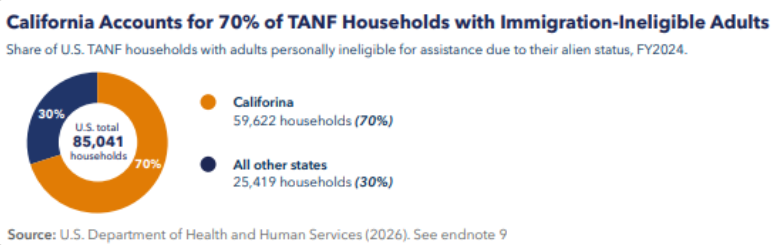
Despite that intent, HHS data indicate that in 2024 over 85,000 TANF recipient families nationwide were headed by adults who were personally ineligible for assistance due to their alien status (which includes, but is not limited to, illegal alien parents). California leads the nation with almost 60,000 households in this category, or about 70 percent of the national total.9 These cases constitute over 20 percent of California’s entire TANF caseload. The next closest state was New York, with approximately 7,000 child-only cases headed by an adult ineligible due to his or her alien status. Nationwide, TANF cash assistance paid to households headed by one or more adults ineligible due to alien status totaled $759 million in 2024, or an annual average of $8,904 per such household. Households often receive additional benefits from other programs, including the Supplemental Nutrition Assistance Program (SNAP, formerly called food stamps) and Medicaid.10
Beyond the significant number of such cases and their large cost for taxpayers, two important policy concerns proceed from the fact that TANF pays welfare checks to households headed by illegal alien parents.
First, despite receiving the TANF payment for eligible children in the household, the ineligible parent is not considered “on” TANF. As a result, work requirements that otherwise apply to citizen or qualified alien parents do not apply to illegal alien adults in these cases. That contributes to the fact that TANF includes a greater percentage of nonworking recipients (46 percent in 2023) than SNAP (41 percent), whose work requirements the One Big Beautiful Bill Act strengthened.11
Second, the payment of child-only TANF benefits to households headed by illegal alien adults undermines other policies meant to reduce dependence on welfare checks. The five-year lifetime limit that otherwise applies to adults collecting federal TANF assistance does not apply in child-only cases.12 HHS data show that almost half of families on TANF in 2024 were exempt from the five-year limit—most often because the adult head was provided child-only benefits.13
That reflects how, even as the TANF caseload has declined sharply, a significant share of remaining cases is exempt from TANF policies designed to limit dependence, including work requirements and time limits.14 That dynamic has had predictable effects. While it did not break out benefit duration by type of household head, a 2024 report from the Chapin Hall Center at the University of Chicago found that “TANF cases with only child recipients have longer periods of TANF participation compared to TANF cases with adult recipients.”15
The Solution:
The Trump administration in a February 2025 presidential action titled “Ending Taxpayer Subsidization of Open Borders” spelled out its goal to “ensure, to the maximum extent permitted by law, that no taxpayer-funded benefits go to unqualified aliens.”16 That action noted that the payment of welfare benefits to illegal alien adults was “acting as a magnet and fueling illegal immigration to the United States,”17 undermining the intent of the 1996 welfare reform law to “remove the incentive for illegal immigration provided by the availability of public benefits.”18 Consistent with that interest, the presidential action called on executive branch agencies to identify federally funded programs that “permit illegal aliens to obtain any cash or non-cash public benefit” and “take all appropriate actions to align such programs with the purposes of this order,” which include ensuring that programs “do not, by design or effect, facilitate the subsidization or promotion of illegal immigration.”19
One action HHS might take is anticipated in their June 2026 issue brief on “The Prevalence of TANF Child-Only Cases Involving Immigration-Status-Ineligible Parents.” In that brief, HHS admitted that current reporting is insufficient to identify whether parents receiving TANF child-only benefits are ineligible due specifically to their status as illegal aliens:
The excluded-parent population therefore can include both non-qualified aliens, including illegal aliens, and some qualified aliens who are still barred from federally funded assistance. ACF’s reporting can distinguish citizens, qualified aliens, non-qualified aliens, and unknown status, but it does not identify illegal aliens as a separate reportable category. It therefore cannot show exactly how many excluded parents are illegal aliens specifically.20
This uncertainty violates the intent of longstanding reporting requirements for households receiving TANF assistance. As part of the new TANF program created in 1996, section 411 of the Social Security Act provides that states must report to the Secretary of HHS the citizenship status of all members of households collecting TANF assistance, including illegal alien parents who receive TANF checks. Specifically, states must collect on a monthly basis, and report to the Secretary on a quarterly basis, disaggregated case record information on “families receiving assistance,” including specifically on the “citizenship of the members of the family.”21 Section 409(a)(2) of the Social Security Act, also created in the 1996 law, provides that if a state fails to provide the required report, the Secretary “shall reduce” the state’s block grant for the succeeding fiscal year by 4 percent.22
As the June 2026 HHS issue brief indicates, current state reporting is insufficient to identify illegal alien parents, as distinct from other ineligible adults, in households receiving TANF assistance—even when illegal alien parents receive the TANF check for the household.23
At a minimum, and in keeping with current Section 411 reporting requirements, HHS should require states (1) to determine the reason why all adults in child-only recipient households are ineligible for TANF assistance, including specifically whether due to an adult being illegally present, and (2) to share that information with HHS and other federal officials.
By failing to satisfy the statutory requirements, current policy permits states to effectively look the other way on collecting and reporting this key data, which in turn facilitates the “availability of public benefits” for illegal aliens that the 1996 welfare reform law sought to prevent and the administration rightly opposes.
States that fail to satisfy this reporting requirement would be subject to the four percent reduction in their annual federal TANF block grant payments that applies under current law. If California failed this reporting requirement, the four percent penalty would mean an annual reduction in federal funding of about $150 million.24 That penalty would be less than California’s majority share of the $759 million currently paid nationwide to child-only households receiving TANF assistance in which an adult is ineligible due to alienage, but it would result in at least some savings for federal taxpayers. Other measures should follow if states repeatedly fail to comply.
Expected Benefits:
If faithfully implemented by states, this change would at a minimum result in greater transparency in the number of households headed specifically by illegal aliens who receive TANF welfare checks. It is reasonable to expect that it also would reduce the number of such households, as the new requirement to identify illegal alien adults would likely cause some families headed by such adults to forgo applying for TANF benefits. Other families might seek out different adults to claim benefits.
This change would likely focus more TANF assistance on households that include only US citizens and eligible noncitizens—instead of “mixed status” households with illegal alien adults, including those who today receive TANF checks. As the Trump administration’s February 2025 presidential action summarizes, that change would better “protect benefits for American citizens in need, including individuals with disabilities and veterans.”25 And it would be consistent with the longstanding intent of US immigration policy to end the availability of public benefits for illegal aliens.
States that fail to comply would lose federal funds, resulting in savings for federal taxpayers and prompting further attention and federal action in those states.
Other benefits include more equity among TANF-receiving households when it comes to the application of work requirements and time limits. Under current law, tens of thousands of households headed by illegal aliens are not subject to those restrictions, while households headed by citizen or eligible non-citizen adults are.
If faithfully implemented by states, the changes could result in some citizen children no longer receiving TANF benefits. That result would be downstream of the fact that their parents are among millions of adults who have illegally entered the United States and often stayed here for many years. Complicated related legal issues, including whether to confer birthright citizenship in such cases, extend well beyond the scope of welfare policy. But federal policymakers can and should effectively enforce the longstanding intent of immigration law to prevent the payment of welfare benefits to illegal alien adults, which TANF and other programs currently allow. Additional options may be available in some cases, such as identifying citizen or legally-present adults, known as representative payees in other programs,26 to dispense benefits for such citizen children.
Endnotes
- The White House, “President Trump Takes Historic Action to Eliminate Wasteful and Harmful Spending,” September 25, 2026, https://www.whitehouse.gov/briefings-statements/2026/09/president-trump-takes-historic-action-to-eliminate-wasteful-and-harmful-spending/.
- Exec. Order No. 14218, “Ending Taxpayer Subsidization of Open Borders,” 90 Fed. Reg. 10581 (Feb. 19, 2025), https://www.federalregister.gov/documents/2025/02/25/2025-03137/ending-taxpayer-subsidization-of-open-borders.
- Personal Responsibility and Work Opportunity Reconciliation Act of 1996, Pub. L. No. 104-193, 110 Stat. 2105 (1996), https://www.govinfo.gov/content/pkg/PLAW-104publ193/pdf/PLAW-104publ193.pdf.
- Steven A. Camarota and Karen Zeigler, “Welfare Use by Immigrants and the U.S.-Born, 2024,” Center for Immigration Studies, February 4, 2026, https://cis.org/Report/Welfare-Use-Immigrants-and-USBorn-2024.
- Christopher F. Rufo, Kenneth Schrupp, and Austen Hufford, “California’s Shadow Welfare System for Illegal Immigrants,” City Journal, September 23, 2026, https://www.city-journal.org/article/california-illegal-immigrants-shadow-welfare.
- Staff of the House Committee on Ways and Means, Summary of Welfare Reforms Made by Public Law 104–193, the Personal Responsibility and Work Opportunity Reconciliation Act, and Associated Legislation, 104th Cong., 2d Sess., Comm. Print WMCP 104-15 (1996), https://www.govinfo.gov/content/pkg/CPRT-104WPRT27305/pdf/CPRT-104WPRT27305.pdf.
- Matt Weidinger, “Welfare Reform at 30: Major Effects and Lessons for Additional Reform,” testimony before the Subcommittee on Work and Welfare, Committee on Ways and Means, US House of Representatives, September 1, 2026, https://www.aei.org/research-products/testimony/welfare-reform-at-30-major-effects-and-lessons-for-additional-reform/.
- Personal Responsibility and Work Opportunity Reconciliation Act of 1996.
- David Swegle and Alex J. Adams, “The Prevalence of TANF Child-Only Cases Involving Immigration-Status-Ineligible Parents,” Administration for Children and Families, US Department of Health and Human Services, https://acf.gov/ofa/policy-guidance/prevalence-tanf-child-only-cases-involving-immigration-status-ineligible.
- Administration for Children and Families, “Characteristics and Financial Circumstances of TANF Recipients, Fiscal Year 2024,” US Department of Health and Human Services, https://acf.gov/ofa/data/characteristics-and-financial-circumstances-tanf-recipients-fiscal-year-2024.
- Office of Human Services Policy, Office of the Assistant Secretary for Planning and Evaluation, Welfare Indicators and Risk Factors, Twenty-Fifth Report to Congress — Appendix Tables, US Department of Health and Human Services, June 5, 2026, https://aspe.hhs.gov/sites/default/files/documents/dbfa8a8b1349c527db830903a57b8867/25th%20Welfare%20Indicators%20Report%20to%20Congress%20-%20Appendix%20Tables.pdf.
- Matt Weidinger, “Welfare Dependence, Revisited,” AEIdeas, April 6, 2023, https://www.aei.org/domestic-policy/opportunity-social-mobility/welfare-dependence-revisited/.
- Office of Family Assistance, “TANF Federal Five-Year Time Limit, Fiscal Year 2024,” Table 3A, Administration for Children and Families, US Department of Health and Human Services, data as of July 1, 2025, https://acf.gov/sites/default/files/documents/ofa/fy2024-timelimit.xlsx.
- Matt Weidinger, “How Liberals Learned to Love Welfare Caseload Reduction,” AEIdeas, June 27, 2023, https://www.aei.org/domestic-policy/opportunity-social-mobility/how-liberals-learned-to-love-welfare-caseload-reduction/.
- Emma Monahan et al., Patterns and Trends in Temporary Assistance for Needy Families (TANF) Participation: Analysis of Longitudinal Federal TANF Participation in 28 States, Chapin Hall at the University of Chicago, June 2024, https://www.chapinhall.org/wp-content/uploads/Chapin-Hall_TANF-Caseload-Dynamics_Brief_June-2024.pdf.
- Exec. Order No. 14218, “Ending Taxpayer Subsidization of Open Borders.”
- Exec. Order No. 14218, “Ending Taxpayer Subsidization of Open Borders.”
- Personal Responsibility and Work Opportunity Reconciliation Act of 1996.
- Exec. Order No. 14218, “Ending Taxpayer Subsidization of Open Borders.”
- Swegle and Adams, “The Prevalence of TANF Child-Only Cases Involving Immigration-Status-Ineligible Parents.”
- Social Security Act § 411, 42 U.S.C. § 611, https://www.ssa.gov/OP_Home/ssact/title04/0411.htm.
- Social Security Act § 409(a)(2), 42 U.S.C. § 609(a)(2), https://www.ssa.gov/OP_Home/ssact/title04/0409.htm.
- Swegle and Adams, “The Prevalence of TANF Child-Only Cases Involving Immigration-Status-Ineligible Parents.”
- Matt Weidinger, “Testimony for the Record, House Committee on Ways and Means Hearing on Misuse of TANF Funds,” October 8, 2024, https://www.aei.org/wp-content/uploads/2024/10/TANF-Testimony-100824-2.pdf.
- Exec. Order No. 14218, “Ending Taxpayer Subsidization of Open Borders.”
- Amy Shuart et al., Issue Brief: Representative Payee Trends, Social Security Advisory Board, September 2026, https://s3-us-gov-west-1.amazonaws.com/cg-778536a2-e58c-44f1-9173-29749804ec54/uploads/2026/09/SSA_Representative-Payee-Trends-Issue-Brief-.pdf.