Liberal policymakers love paying more government benefits but hate the fact that doing so often requires Congress to pass laws, such as when it temporarily authorizes extended unemployment benefits in recessions. That’s one reason why in recent years some have proposed creating new unemployment rate “triggers” to automatically pay federal benefits without Congress needing to act in response to recessions. But an analysis of one such proposal reveals that, had it been enacted, today the US would be paying federal extended unemployment checks—which are normally reserved for recessionary periods—in 24 states. That is despite what at present is the longest stretch of low unemployment in recorded American history. That reflects not just extremely poor targeting. It also offers a cautionary tale as the same policymakers recently proposed deploying similar triggers to automatically pay more unemployment checks in response to fears of AI-induced layoffs.
Background on Extended Unemployment Benefits
In response to every recession in recent memory, Congress has passed laws that created temporary programs providing federal extended unemployment benefits to people who exhaust regular state unemployment insurance (UI) checks. The policy logic is simple: when unemployment is elevated, the unemployed may need more time to find a new job and should be supported with extended benefits. For example, during and after the 2007-09 Great Recession, Congress passed a dozen laws that created, expanded, and continued temporary programs paying federal extended unemployment checks. Combined with state UI checks, those temporary programs paid a record up to 99 weeks of unemployment checks per person and operated for an unprecedented five and a half years. When labor market conditions improved, Congress let the temporary programs expire, as it always does.
Despite those temporary programs’ record duration and benefit payouts, for some it wasn’t enough, because for them it’s never enough. Former Obama administration officials and academics in 2019 authored a volume called Recession Ready, which argued the temporary programs that operated during and after the Great Recession were “not sufficiently large” and “discontinued prematurely.” Their proposed “solution”: to automatically pay out a spate of federal benefits—extended and expanded unemployment checks, stimulus checks, bigger food stamps, more welfare checks, more aid to states, and even elevated infrastructure spending—whenever unemployment rates exceeded pre-set levels. Once those “trigger” unemployment rates were set, Congress wouldn’t need to act again, the argument went.
2021 Wyden/Bennet Proposal
Liberal politicians took notice. In April 2021, Senator Ron Wyden (D-OR), who then chaired the Senate Finance Committee, along with Senator Michael Bennet (D-CO), proposed UI “modernization” legislation that would automatically pay extended and expanded federal unemployment checks whenever unemployment rates exceeded pre-set levels. That legislation didn’t advance, but in a new proposal recently featured in the New York Times and nominally designed to address AI-related job losses, Wyden and Bennet are joined by Minority Leader Chuck Schumer (D-NY) and Senator Elizabeth Warren (D-MA) in calling for a similar “automatic” response to expanding unemployment benefits. “Americans feel the looming fear of AI job losses, and Congress has a responsibility to help the country prepare,” Wyden argues.
In assessing the merits of this most recent “trigger” proposal, it’s useful to consider what would have happened had lawmakers enacted the similar 2021 Wyden/Bennet proposal. A basic question is this: if that prior proposal had been enacted, in how many states would federal extended unemployment benefits now be payable?
The surprising answer is that, under the 2021 Wyden/Bennet proposal extraordinary federal benefits would now be paid in 24 states, which include approximately 44 percent of the US population. Yet not only is the US not currently in recession, Congress is not even considering providing such temporary benefits today. Based on its prior actions, it never would have before, either. In fact, in October 2026 the U.S. had a historically low 4.1 percent unemployment rate, which has been at or below 4.5 percent for a record 60 consecutive months.[1]
The 2021 Wyden/Bennet proposal called for three distinct new “total unemployment rate” (TUR) triggers for paying federal extended benefits, each of which assess the most recent three-month average of seasonally adjusted unemployment rates for each state and the US.[2]
The first proposed trigger is the most straightforward. It would pay 13 weeks of extended unemployment benefits, fully supported with federal funds, whenever the state or national TUR is “at or above 5.5 percent.” The current US TUR (which as of November 6 averages the seasonally adjusted monthly unemployment rates for October, September, and August) is a historically low 4.2 percent, meaning benefits would not currently be triggered on nationwide. But unemployed individuals in the District of Columbia (which currently has a 5.7 percent TUR) and Puerto Rico (6.1 percent), both of which are considered “states” under the UI system, would qualify for federal extended benefits.[3]
[1] That is, for each month extending back to October 2021. The Bureau of Labor Statistics did not report data for October 2025 because of the government shutdown, so that month is skipped in this count.
[2] The TUR for each state is already calculated and reported weekly in Extended Benefits Trigger Notices issued by the Department of Labor. The federal-state Extended Benefits (EB) program currently uses several “optional” TUR triggers for paying EB program benefits, which under permanent law are supported with 50 percent state funds. However, those TUR triggers pay EB benefits only at unemployment levels significantly higher (starting at 6.5 percent TUR, among other conditions) than the TUR triggers proposed in the April 2021 draft. Further, as the latest trigger notice indicates, 41 of 53 states in the UI system have chosen not to use the optional 6.5 percent TUR trigger. A number of those states automatically adopt that optional TUR trigger when the federal government provides 100 percent of EB program funding, as occurred in the past two recessions. For additional background, see the Department of Labor’s most recent Comparison of State Unemployment Laws.
[3] The Bureau of Labor Statistics Local Area Unemployment Statistics program does not provide seasonally adjusted civilian labor force data for the US Virgin Islands which, despite being considered among 53 “states” in the UI system, is not included in the counts in this piece.
That’s just the beginning. A second trigger “augments” the current state or US TUR by adding the degree to which it has risen compared with its lowest level in the past three years. If that sum equals 5.5 percent or more, then extended benefits are payable. The lowest US TUR in the last three years was 3.7 percent for the three months ending in January 2024, reflecting a difference of 0.5 percentage points from the current 4.2 percent level. Thus the US “augmented” trigger (4.2+ 0.5 = 4.7 percent) does not rise to 5.5 percent.
Under this second trigger, 12 individual states (Arizona, Connecticut, Delaware, District of Columbia, Florida, Maryland, Michigan, Minnesota, New Mexico, Oregon, Puerto Rico, and Washington) would qualify for extended benefits, since the sum of their current TUR and the rise compared with their lowest level in the past three years is at least 5.5 percent.
In Connecticut, the District of Columbia, and Puerto Rico, the augmented TUR would be high enough (that is, above a second 6.5 percent threshold) to trigger the payment of 26 weeks of benefits, instead of 13 weeks as in the other states surpassing only the 5.5 percent threshold.
Finally, a third proposed TUR trigger in the 2021 proposal reflects what is widely known as the “Sahm rule,” judging whether the current state or national TUR “is at least 0.5 percentage points higher” than its lowest level “in the preceding 12 months.” The US TUR has been effectively flat for the past year, so the national Sahm rule is not currently satisfied. However, under the state side of this trigger, nine states (Alabama, Arizona, Connecticut, Florida, Hawaii, Kentucky, New Mexico, Oklahoma, and Puerto Rico) would qualify for extended benefits today. Despite recent increases, unemployment rates in some of those states remain remarkably low. The current TUR in Alabama is 3.4 percent, and in Hawaii it is even lower at just 2.7 percent.
That tells only part of the Sahm rule trigger story. Unlike the first two triggers, which simply turn the program off whenever the TUR or augmented TUR falls below 5.5 percent, the third trigger includes distinct “off” criteria which, once benefits are triggered on, continue the program until those criteria are met. These criteria turn the program off when the state or national TUR (1) has “decreased for not less than 2 consecutive months,” (2) is less than 5.5 percent, and (3) is less than 1.5 percentage points above the TUR when the program turned on.
In addition to the nine states currently eligible under the “on” criteria of the third trigger, the “off” rule would maintain eligibility for 12 states previously made eligible by but no longer satisfying those “on” criteria today. The 12 states include California, District of Columbia, Idaho, Iowa, Kansas, Maine, Maryland, Minnesota, Nebraska, Oregon, Vermont, and Virginia. These states continue to qualify today because they have yet to satisfy the “off” criteria, especially the requirement for two consecutive months of TUR decline.[4] Several of these states (California, District of Columbia, Iowa, and Minnesota) would be nearing the end of their fourth consecutive year of extended benefit eligibility due to the expansive “off” criteria of the third trigger.
[4] Projections throughout are based on TURs carried to the first decimal place. For purposes of the “off” trigger, estimates consider a decline to mean the TUR rounded to the first decimal place has fallen from one month to the next, and ultimately has fallen for two consecutive months for the program to expire. In the end, as the legislative text of the October 2026 proposal notes, such “determinations of the rate of total unemployment…shall be made by the Secretary.”
The irony of the third trigger’s paying federal extended unemployment benefits today would be especially thick in California, where in October Governor Gavin Newsom bragged about the state’s economy “dominating” other states, including because the Golden State “is a leader in increasing wages and salaries.” Some states would have been eligible for benefits under more than one trigger (or by remaining eligible due to failing to meet the third trigger’s off criteria), which could compound weeks of benefits payable in those states under the proposal. Overall, the 2021 Wyden/Bennet proposal would provide 13 or more weeks of federal extended unemployment benefits today in 24 states: Alabama, Arizona, California, Connecticut, Delaware, District of Columbia, Florida, Hawaii, Idaho, Iowa, Kansas, Kentucky, Maine, Maryland, Michigan, Minnesota, Nebraska, New Mexico, Oklahoma, Oregon, Puerto Rico, Vermont, Virginia, and Washington. In nine of those states (Arizona, Connecticut, District of Columbia, Florida, Maryland, Minnesota, New Mexico, Oregon, and Puerto Rico) 26 weeks of federal extended benefits would be payable today, either because they qualified under more than one trigger or had high augmented TUR rates that qualified them for more weeks of benefits.
The above review generally considers only the question of the number of states that would currently qualify for federal extended benefits under the 2021 Wyden/Bennet proposal. In a December 2022 report, I assessed how the same April 2021 proposal, if effective then, would have dramatically expanded federal extended benefit payments in late 2021 and 2022—that is, during the period immediately after the Biden administration and a Democratic-controlled Congress allowed federal pandemic extended benefit programs to expire. As displayed in Figure 1 below, that review found that, in dozens of states, the April 2021 proposal’s various triggers would have continued federal benefits well beyond their legislated expiration around Labor Day 2021.
Figure 1: Continued Payment of Federal Extended Benefits After Labor Day 2021 Under the US and State TUR and Augmented TUR Triggers, by Number of States and Governor’s Party
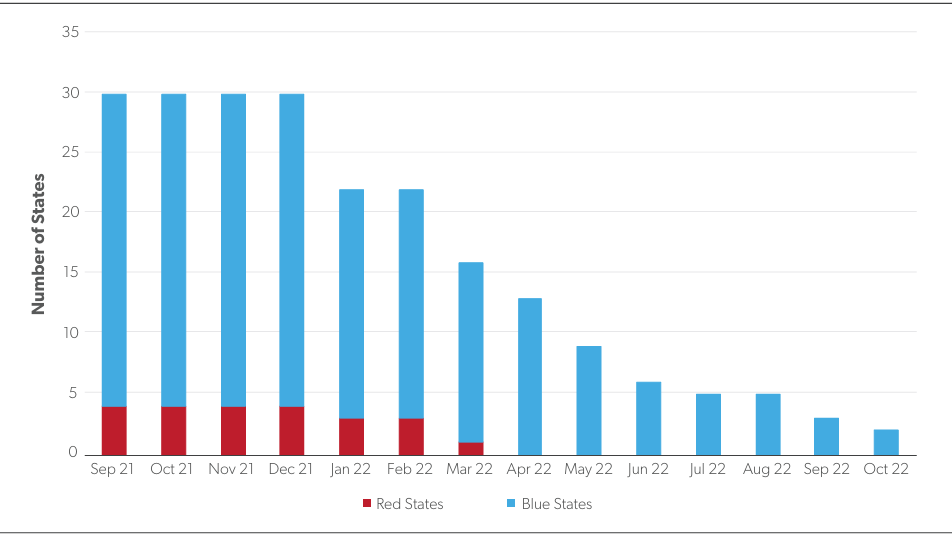
Note: This figure assumes states that sought to opt out of PEUC in mid-2021 succeeded. It also reflects that PEUC benefits remained payable in Alaska, Arizona, Florida, and Ohio, even as those states discontinued other federal benefits. State augmented TURs are calculated by comparison with state TURs in 2020.
As Figure 1 displays, blue states dominate where federal benefits would have continued under these proposed triggers, including in some states for a full year after Congress allowed temporary programs to expire. In January 2022, individuals in major blue states like California, Illinois, New Jersey, and New York would have continued to qualify for a full year of federal extended benefits—four months after a Congress led by Democratic majorities and the Biden administration allowed those programs to expire. In California alone, the additional costs for taxpayers would have easily run into billions of dollars.
October 2026 Wyden/Bennet/Schumer/Warren Proposal
Like the 2021 proposal, the proposal released on October 23, 2026 by Senators Wyden, Bennet, Schumer, and Warren nominally to address AI-induced unemployment would automatically trigger the payment of federal extended benefits whenever unemployment rates exceed pre-set levels. In contrast with the 2021 Wyden/Bennet proposal, however, the October 2026 proposal deploys only a subset of the prior proposal’s TUR triggers: it adopts the full first TUR trigger described above along with a modified version of the third trigger—using only the national Sahm rule, not the Sahm rule for individual states. The October 2026 proposal completely drops the earlier proposal’s second “augmented” trigger.
Under that revised set of triggers, extended benefits would be payable today in two states: the District of Columbia and Puerto Rico, both of which have TURs at or above 5.5 percent. The other 22 states that previously would have qualified under the second “augmented” trigger or the state Sahm rule trigger would not qualify today under the revised proposal.
No state would today be eligible for extended benefits under the third trigger, as the US TUR has been essentially flat for the past year. But policymakers should note that the national Sahm rule trigger would have been “on” in all states from July through September 2024. During those months, the national TUR remained historically low (averaging 4.2 percent) but nonetheless had risen by at least 0.5 percentage points during the past 12 months. That would have resulted in the payment of federal extended unemployment benefits in all states during the heart of the 2024 campaign, undercutting President Biden’s claims that the US then had “the strongest economy in the world.”
In August 2024, a Washington Post economist pointed to the Sahm rule in suggesting that recent unemployment rate increases meant the US “could be in the early stages of a recession.” In response, economist Claudia Sahm cast doubt on her eponymous rule, stating she was “confident that we are not in a recession” and reiterating themes from her November 2023 op-ed, “Why My Recession Rule Could Go Wrong this Time.”
Despite those denunciations, as a result of the third trigger’s “off” criteria (especially the requirement that the national TUR decline for two consecutive months before the program turns off), federal extended benefits would have remained payable in all 53 states and territories through July 2026, a span of more than two years.
Yet, the national Sahm rule (including “off” conditions identical to those in the April 2021 draft and phaseout rules continuing benefits for up to six months after the off trigger is reached) remains a proposed trigger under the October 2026 proposal.
Concluding Thoughts
This review spotlights several concerns with using recently proposed unemployment rate triggers to automatically pay extended federal unemployment benefits.
First, the triggers proposed in the 2021 Wyden/Bennet draft were extremely poorly targeted and would have resulted in the current payment of extended unemployment benefits in almost half of all states, including where unemployment conditions are remarkably low.
Second, even the narrower trigger criteria in the October 2026 Wyden/Bennet/Schumer/Warren proposal would today provide for the payment of extended benefits in two states (the District of Columbia and Puerto Rico).
More significantly, under the proposed national Sahm rule trigger included in the October 2026 proposal, extended benefits would have been payable in all states starting in July 2024 and extending through July 2026, mostly due to that trigger’s flawed “off” criteria. Phaseout rules make it likely that some individuals still would be collecting extended benefits in all states today. Again, that would be in the midst of the longest period of low unemployment in the nation’s recorded history.
Under the national Sahm rule trigger alone, federal extended benefit programs would have operated for considerably longer in recent years (a total of 25 months) than they did during the height of the pandemic (19 months from March 2020 through September 2021). During the more recent period, the national TUR averaged 4.2 percent, or more than a full percentage point less than the 5.5 percent national TUR (for the three months ending in August 2021) when the Biden administration and a Democratic-led Congress allowed pandemic extended benefits to expire in September 2021.
During recent years especially, national labor market conditions were objectively strong and AI-induced job losses, nominally the purpose of the latest proposed expansion, were nowhere to be found in either unemployment rate conditions or claims for unemployment benefits.
One additional factor merits attention. As I noted in a 2022 report, blue states tend to have higher unemployment rates, meaning proposals that direct federal benefits based on elevated unemployment inherently advantage them over red states. For example, the TUR for the District of Columbia has been at or above 5.5 percent—the level at which federal extended benefits automatically would be paid under the latest proposal—in almost 90 percent of all months since 1976. In California, the TUR has been at or above 5.5 percent in 71 percent of all months since 1976. Those reflect the minimum periods during which federal extended benefit programs would have operated in the past if such policies had been in effect then. Phaseout rules and the national Sahm rule trigger (including its expansive “off” criteria) would have further expanded the scope of federal benefit payments. Meanwhile, in red South Dakota the TUR has reached 5.5 percent in only 2 percent of all months during the past 50-plus years.
In sum, the first trigger alone constitutes a prescription for frequently paying greater federal benefits in some blue states, while systematically excluding red states where unemployment rates are often low. While the first trigger can at least claim to offer benefits targeted to states where unemployment is elevated, this analysis shows how the national Sahm rule trigger in recent years would have paid extended benefits in all states while national unemployment rates were near historic lows. In July 2024, when that trigger would have turned on the program in all states, extended benefits would have been payable in 31 states with a TUR of 4.0 or less, including 12 states with a TUR of 3.0 or lower. Even South Dakota, with a microscopic 1.8 percent TUR, would have qualified.
The payment of such benefits is decidedly outside of the policy norm, reflected in the fact that Congress has never designed a temporary program in low-unemployment conditions like we currently have, and there are no calls from any quarter to create such a temporary extended benefits program now.
That, ironically, may be the point. For liberal policymakers ultimately seeking greater federal benefit payments, the only way to significantly expand benefits may be to put such considerations on autopilot, as these flawed trigger proposals would do. Lawmakers should be aware of not only the large benefit expansions such proposals would entail, but also their high cost—in poorly targeted benefits, lengthened unemployment durations, and excessive taxpayer spending.