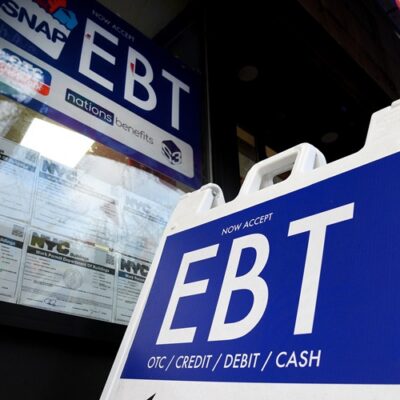
The Food and Nutrition Administration, which oversees the federal Supplemental Nutrition Assistance Program (SNAP), proposed a regulation this month ending Broad-Based Categorical Eligibility (BBCE). The proposed rule would end the practice of conferring SNAP eligibility to households based on broad interpretations of what it means to receive government benefits. Thus far, BBCE has allowed states to expand SNAP’s income eligibility beyond the statutory limit and eliminate the program’s asset test. While those applications should end, BBCE protects certain SNAP recipients from benefit cliffs and outdated asset tests. Without BBCE, these issues will resurface. Congress should address them in the next farm bill.
SNAP sends almost $7 billion in food benefits each month to eligible households and is one of the country’s main programs to help low-income households. Eligibility and benefit amounts are determined by household size, age, disability status, income, and expenses. Generally, households with gross incomes below 130 percent of the federal poverty level (FPL), or approximately $42,900 annually for a family of four, are eligible for SNAP.
Categorical eligibility is a practice that allows states to grant SNAP eligibility to families who are also receiving benefits from other government programs with comparable eligibility rules, such as the Temporary Assistance for Needy Families (TANF) program or Supplemental Security Income. The intent behind the practice is to avoid assessing eligibility twice for programs with similar rules. While the rule is intended to promote efficiency and reduce applicant burden, its practical benefits are often limited. For example, a TANF-receiving family must still provide the documentation necessary to determine SNAP eligibility in order to calculate their SNAP benefit amount. While categorical eligibility may eliminate some duplicative efforts, the resulting time and administrative savings are often marginal.
The limited administrative savings associated with categorical eligibility raise additional questions about the use of BBCE. BBCE is a form of categorical eligibility that broadly defines what it means to “receive benefits” through TANF. The Department of Agriculture established this practice through administrative guidance in 2009, defining a TANF-funded benefit very broadly. TANF allows states considerable flexibility to offer services that do not impose traditional income eligibility requirements. Thus, BBCE allows states to expand SNAP eligibility by using TANF’s broader income and asset limits to set eligibility from the start.
Over time, it has become clear that states have exploited the definition of a TANF service to expand SNAP’s eligibility limits and eliminate the asset test. For example, some states give SNAP-applying households a TANF-funded brochure to expand eligibility. The newly proposed rule eliminates this broad interpretation of a TANF service, narrowly defining TANF receipt as cash assistance, which carries a traditional eligibility determination process. This likely would result in SNAP returning to its statutory income and asset limits in states that currently use BBCE, unless states expand TANF cash assistance eligibility as well.
While the use of BBCE has gone well beyond the initial intent of categorical eligibility, it has addressed two important problems within SNAP. The first is benefit cliffs. As Erik Randolph and I outlined in 2025, a misalignment in SNAP’s benefit formula means that some households face a benefit cliff as they approach SNAP’s statutory income eligibility limit of 130 percent of FPL. In this context, a benefit cliff is an abrupt loss in SNAP benefits as income rises, rather than a phasing out to near zero. Benefit cliffs discourage employment and can impede households from moving up the income ladder. BBCE allows states to extend the income eligibility limit to 200 percent of FPL, giving households more room to phase out the SNAP benefit and reducing (although not eliminating) the potential cliff.
The second problem involves outdated asset tests. SNAP’s eligibility rules limit the amount of countable assets a household can have to $3,000 or $4,700 for households with a disabled or elderly member. These limits do not adjust for inflation each year, and research suggests that such asset tests can reduce savings. Incompatible with current economic conditions, these asset tests can also discourage income-eligible households from applying for SNAP.
Ending BBCE is a necessary action to stop program expansions through administrative rules rather than congressional legislation. However, the end of BBCE also exposes households to two fundamental problems within SNAP—benefit cliffs and outdated asset tests that reduce savings.
The new Congress is expected to pass a farm bill in the upcoming year. This provides an opportunity to address benefit cliffs and asset tests through legislation rather than administrative rule. Congress should consider realigning SNAP’s benefit rules to allow them to phase out to zero and increasing SNAP’s asset test.