In 1964, when Congress passed the Food Stamp Act, the country faced a problem of inadequate nutrition among low-income Americans due to insufficient food. In response, the Food Stamp Program—today known as the Supplemental Nutrition Assistance Program (SNAP)—was created. Sixty years later, the nation faces a very different challenge. While reducing hunger remains an important policy goal, preventing obesity and related chronic diseases has become the nutritional issue of our time.
SNAP remains the country’s primary nutrition assistance program, helping on average 38 million Americans afford food each month. At a cost of almost $100 billion last year, SNAP provided substantial resources to low-income households and continues to do so every year. While SNAP has been effective at reducing food insecurity, evidence suggests it has not improved diet quality and may even support poor dietary habits. The next phase of SNAP reforms must focus on improving the nutrition and health of low-income Americans. Recent state-led efforts to experiment with SNAP restrictions offer an important opportunity to build evidence for effective strategies.
Background
SNAP has grown dramatically in recent decades as the nutrition landscape has changed. In 2000, approximately 6 percent of the population received food stamps, and by 2023 that share doubled to roughly 12 percent, with a substantial shift in the composition of SNAP participants toward childless adults and the elderly. As SNAP participation increased, so too did spending. SNAP is no longer a relatively small safety net program focused on avoiding hunger for households with children; rather, it is now a central component of the safety net, with most low-income households participating in it at some point.
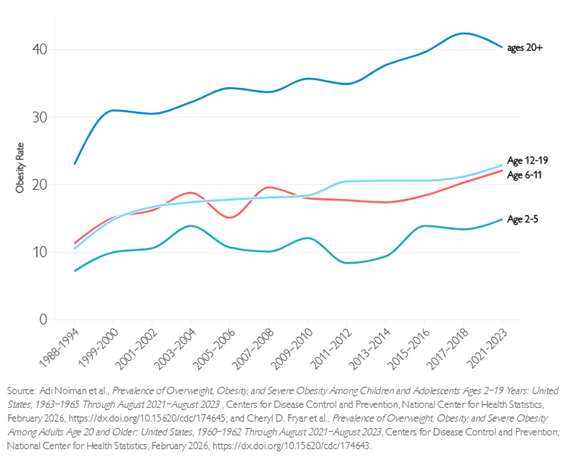
At the same time, obesity rates and diet-related diseases have increased dramatically. According to the Centers for Disease Control and Prevention (CDC), 40.3 percent of all adults have obesity, while 9 percent suffer from severe obesity. Data show that low-income adults suffer from obesity and severe obesity at roughly the same rates as middle-income individuals, and higher rates than upper-income adults. However, low-income children have higher rates than middle- and high-income counterparts. As of 2023, 21.1 percent of children had obesity and 7 percent had severe obesity. While obesity rates appear to be leveling off for adults due to new treatment options, obesity rates continue to alarmingly rise for children.
Figure 1: Obesity Rates by Age
Obesity and poor diet are major risk factors for multiple diseases. Among low-income adults, 47 percent suffer from hypertension and 20 percent from diabetes. The CDC estimates that 90 to 95 percent of diabetes cases are diagnosed as type 2 diabetes, which is oftentimes linked to obesity, being overweight, and poor diet.
If SNAP unintentionally contributes to poor diet quality and exacerbates health issues for low-income individuals, policymakers need to act. Poor health can reduce employment opportunities, limit productivity, and impose significant emotional and social costs on families. These consequences can make it more difficult for low-income Americans to achieve economic stability and upward mobility. Improving nutrition is therefore not simply a public health objective; it can also be part of a broader strategy to help families thrive.
Addressing Poor Diet Quality Among SNAP Households
Poor diet quality and high rates of chronic disease are not unique to SNAP households, but their high prevalence among low-income populations raises questions over whether SNAP could do more to address these issues. As the federal government’s primary nutrition assistance program, a main policy objective should be improving nutrition and supporting good health. However, evidence suggests that SNAP participants have comparatively worse diet quality than income-eligible nonparticipants, raising the possibility that factors beyond income alone may contribute to these differences.
Research suggests that the relationship between poor diet quality and low income is not straightforward. One study found that SNAP participants purchased a different nutritional profile of foods than nonparticipants, including income-eligible nonparticipants. Another study in Massachusetts examined the impact of a 25 percent average increase in SNAP benefits in 2021, finding that the increase in benefits had no impact on the differences in diet quality between participants and eligible nonparticipants. This implies that income cannot be the only driver of poor diet quality among SNAP households.
SNAP purchase data suggests that a substantial share of SNAP dollars is spent on items with little nutritional value and these items are purchased at higher rates among SNAP households than non-SNAP households. This suggests that households may treat SNAP funds differently, which is supported by evidence from a 2018 study that challenges the assumption that SNAP benefits and cash are fungible. One way to address poor diet quality is to offer monetary incentives to SNAP households to purchase healthy food, such as fruits and vegetables. Since 2014, Congress has authorized states to operate incentive programs providing additional SNAP dollars to participating households for the purchase of fruits and vegetables. One evaluation of an early pilot program, the Healthy Incentives Program (HIP), operated as a randomized control trial. HIP offered 30 percent more benefits on top of regular SNAP for households to purchase fruits and vegetables. The evaluation found that HIP increased fruit and vegetable expenditures and consumption but did not affect consumption of other items, such as sweetened beverages. It also improved diet quality as measured by the Healthy Eating Index (HEI), but participants still fell below recommended dietary guidelines for Americans—indicating that SNAP’s incentive programs may have advantages but are still insufficient to meet the scale of the problem.
Food Restriction Waivers in SNAP
Another policy tool is the restriction of low-nutritional foods eligible for SNAP purchases. For the first time starting in 2026, almost half of US states will operate SNAP restriction pilots and evaluate the results.
Concerns over the quality of SNAP purchases date back several decades. Debates over the initial authorization of the 1964 Food Stamp Act included efforts to exclude soft drinks and “luxury foods,” although the final bill included no such exclusion. However, as obesity and diet-related disease became larger public policy issues in the early 2000s, states started expressing concern over the toll they were taking on their residents and local economies through rising public health insurance costs and declining worker productivity.
Minnesota in 2004 was the first state to seek greater authority from the US Department of Agriculture (USDA) to restrict SNAP purchases. New York City made a similar request in 2010, seeking to conduct a two-year demonstration restricting sugar-sweetened beverages. Maine also sought analogous permissions beginning in 2015 and running through 2017. However, attempts made by all three jurisdictions were ultimately rejected by the USDA, which cited concerns about the size and scope of the proposal, retailer challenges, product definitions, and difficulties associated with identifying a strong comparison group. Throughout these years, coalition groups encouraged the USDA to allow SNAP restriction pilot programs, including a letter in 2013 to then Secretary Thomas Vilsack from 54 health organizations asking the federal government to test restrictions.
By 2025, the Make America Healthy Again campaign had reintroduced the idea that SNAP should not support unhealthy food. Robert F. Kennedy Jr. penned a Wall Street Journal opinion piece in September 2024 encouraging a federal policy to stop the subsidization of soda and processed food, leading to the poor health of low-income Americans. He included a proposal to allow the USDA to restrict SNAP purchases. By February 2025, Kennedy was secretary of the Department of Health and Human Services and Brooke Rollins was agriculture secretary overseeing SNAP; both expressed their desire to use SNAP to improve nutrition and address chronic disease, including allowing state waivers to implement SNAP restrictions.
In May 2025, Nebraska became the first state granted such a waiver by Secretary Rollins, prohibiting soda and energy drink purchases with SNAP funds. Since then, Rollins has approved 22 additional waiver requests, with 12 currently in effect. However, a June 2026 court ruling vacated waiver approval in five states and paused their operations: Colorado, Iowa, Nebraska, Tennessee, and West Virginia. The USDA Food and Nutrition Administration has appealed the decision, and implementation is ongoing in states not covered by the court ruling.
Most waivers restrict various combinations of soda or soft drinks, energy drinks, and candy. Some states have broader restrictions, including Arkansas, which prohibits fruit and vegetable drinks, and Florida, which bans prepared desserts. All waiver approvals include a requirement that the state evaluate its pilot project. Most states have proposed analyzing a combination of retailer transaction data, SNAP spending data, and participant surveys to monitor longitudinal trends in spending patterns on both restricted items and nutrient-dense foods.
Are SNAP Restrictions Working?
The logic for restricting SNAP purchases of unhealthy foods rests on a few expected outcomes. First, restrictions should reduce purchases of restricted items made with SNAP benefits. This is the most immediate and likely effect of a restriction and the easiest to measure using retailer transaction data. Second, restrictions should reduce overall purchases of restricted items, including those supported by non-SNAP benefits. Third, purchases should extend to actual consumption. Ideally, the reduction in the purchase of restricted items will lead to healthier substitutions among participants. From an evaluation perspective, consumption is more difficult to measure because it generally requires collecting information directly from program participants.
Understanding how SNAP restrictions affect purchasing and consumption is important, but so is knowing whether restrictions improve nutrition and, ultimately, health. Improved health can cover a variety of definitions: One concept might be fewer calories consumed overall, but an even more important concept is a healthier mix of calories consumed. This can be measured by the Healthy Eating Index (HEI), but HEI scores require careful interpretation. For example, decreasing added sugar consumption can have limited effects on an HEI score when baseline levels of healthy items remain low. Furthermore, even if SNAP restrictions result in reduced consumption of restricted items and higher overall HEI scores, the ultimate desire is to reduce rates of obesity and diet-related diseases.
To assess whether SNAP restrictions impacted any of these outcomes, evaluators need to identify a useful comparison group. In the absence of randomized control trials, this could consist of SNAP participants from a neighboring state without restrictions or phasing in restrictions county by county. However, this is one of the more challenging tasks for assessing programs with risks of substantial attrition over time.
Despite the difficulties in evaluation studies, SNAP restriction pilots can still be informative. Three recent working papers offer cautious optimism over the ability of such pilots to reduce restricted-item purchases and affect consumption.
A working paper published in August 2026 examined purchasing data for 10 states implementing restriction waivers from January through April 2026. Researchers found that the restrictions reduced soda purchases by 13 percent and that purchasing patterns did not support SNAP benefits as fungible with cash. Importantly, these researchers relied on variation in the rollout of the restrictions for comparison, using a large dataset that combined online and in-store product-level purchasing, household and geographic characteristics, and self-reported quarterly information on SNAP participation.
In a separate but similar study, researchers examined the same 10 states implementing restriction waivers in early 2026, using nationwide grocery-store panel data to document retail purchases. They found a reduction in overall restricted sugary beverages of 12.4 percent in waiver states, rejecting the notion that SNAP benefits are fungible with cash. Importantly, they found some substitution effects toward non-excluded sugary beverages in states that did not exclude all sugary beverages from SNAP.
In yet another study, published in September 2026, researchers used this same panel data to explore changes in restricted-item purchases as well as reductions in caloric intake. They found the same level of soda purchase decline (12 percent), as well as reductions in the purchase of candy (8 percent) and energy drinks (13.4 percent). They also found that calories from soda purchases, total sugar, and sodium each fell by 12.3 percent, 12.5 percent, and 11.6 percent, respectively.
Conclusion
Although it is still early, current SNAP waivers suggest that restrictions have changed behavior, but they also illustrate an important limitation: Discouraging people from purchasing unhealthy food does not necessarily encourage them to purchase more healthy food. Final conclusions on the effectiveness of SNAP restrictions will require more time and data on overall purchases, consumption, and diet quality.
The broader goal should be to move SNAP toward a more modern understanding of nutrition. The program was developed at a time when the central concern was ensuring that low-income families had enough food to eat. While that objective remains important, today’s nutritional environment requires policymakers to consider not only the quantity of food available to families but also the quality of that food. SNAP cannot solve America’s chronic disease problem by itself—but it can be part of the solution.