The Supplemental Nutrition Assistance Program (SNAP, formerly called food stamps) is an important safety-net program that helps reduce hunger and decrease poverty among US households. At the same time, SNAP has significant flaws that make it inefficient, less effective than it could be, and in some cases harmful to upward mobility. However, recent actions by Congress combined with executive-branch decisions have set the stage for significant changes to SNAP in 2026.
For context, SNAP serves more than 22 million low-income households in the US each month, helping more than one in eight Americans afford food for themselves and their families. Although administered by states, the program is funded primarily by the federal government and distributes roughly $8 billion per month to participating households. According to federal data, the average SNAP household received about $350 in SNAP benefits in September 2025 (the most recent month of data). One-third of SNAP households include a child, while nearly 60 percent consist of a single individual.
In July 2025, Congress passed and President Trump signed the One Big Beautiful Bill Act (OBBBA), which among other things, addressed several issues related to SNAP. Concerns over SNAP’s performance in recent years has centered on five key areas – program integrity, employment, nutrition, increasing costs, and financing structure – and the OBBBA touched on many of these. Outside of the legislative process, the Food and Nutrition Service (FNS) of the US Department of Agriculture (USDA), which is the federal agency that oversees SNAP, has approved state requests for new policies designed to improve nutrition and will likely issue new regulations that tighten eligibility standards.
Here is what to expect in 2026 and beyond, representing some of the most consequential changes to SNAP in recent years.
- Addressing payment errors and misuse of SNAP dollars. In 2026, we will see more scrutiny by state and county officials of SNAP eligibility and benefit amounts. State and county agencies process SNAP cases, but the federal government covers 100 percent of benefit costs. This leaves little incentive for states to limit payment errors, which can occur when staff make mistakes and fail to put in place sufficient quality control measures. The most common mistake among state agencies is income-related, such as staff relying on unverified income sources or miscalculating household resources. In fiscal year 2024, the average payment error rate in SNAP was 11 percent, with a 9 percent overpayment rate (the other 2 percent involved underpayments). This was among the highest average payment errors in at least the past decade, accounting for $10 billion in overpayments last year.
The OBBBA strengthened penalties for SNAP errors by requiring states with error rates at or above 6 percent to cover a portion of their state’s SNAP benefits. Although this requirement does not take effect for nearly two years (effective October 1, 2027), the federal government will calculate states’ cost-sharing obligations using payment error rates from either FY 2025 or FY 2026, making their current operations consequential. Beginning in FY 2029, cost-sharing will be based on the average payment error rate over the prior three years.
While FY 2025 payment error rates are not yet available, FY 2024 data show that only nine states or territories had payment error rates below 6 percent. As a result, most states will need to reduce errors this year or face new and substantial financial obligations for SNAP starting in FY2027. This will likely lead to immediate changes to eligibility determination and quality control operations across states, such as increased scrutiny of documentation submitted by participants, more frequent and reliable matches to income data, and increased investigations of the causes of errors. - New work requirements. We will also see a much larger share of the SNAP adult population subject to work requirements starting this year, including those who were previously living in an area that received a waiver of work requirements. The OBBBA expanded the maximum age of non-disabled SNAP adults subject to work requirements from 54 to 64 and narrowed the exemptions to only those adults with dependent children under age 14. The OBBBA also limited waivers only to areas with unemployment rates in excess of 10 percent, and the FNS terminated all existing waivers (that is, states have to currently meet the new criteria to receive a waiver). These changes will require state and county agencies to assess the work readiness of more SNAP participants and to enforce work requirements for a larger share of the SNAP population.
For the first time, SNAP’s work requirements will cover a majority of work-capable SNAP adults. The change in waiver policy will reduce the share of counties eligible for a waiver from 45 percent to nearly 0 percent assuming the unemployment rate remains low. Additionally, 55 percent of work-capable, non-elderly SNAP adults will be subject to the work requirement as shown in Figure 1, with 25 percent newly subject to the requirement. Across most parts of the US, the unemployment rate is relatively low, suggesting that jobs are available for non-working SNAP adults. However, state officials will need to monitor their SNAP caseload and ensure that those newly subject to the work requirement understand the expectation, have access to the workforce development system, and move into employment or volunteer opportunities.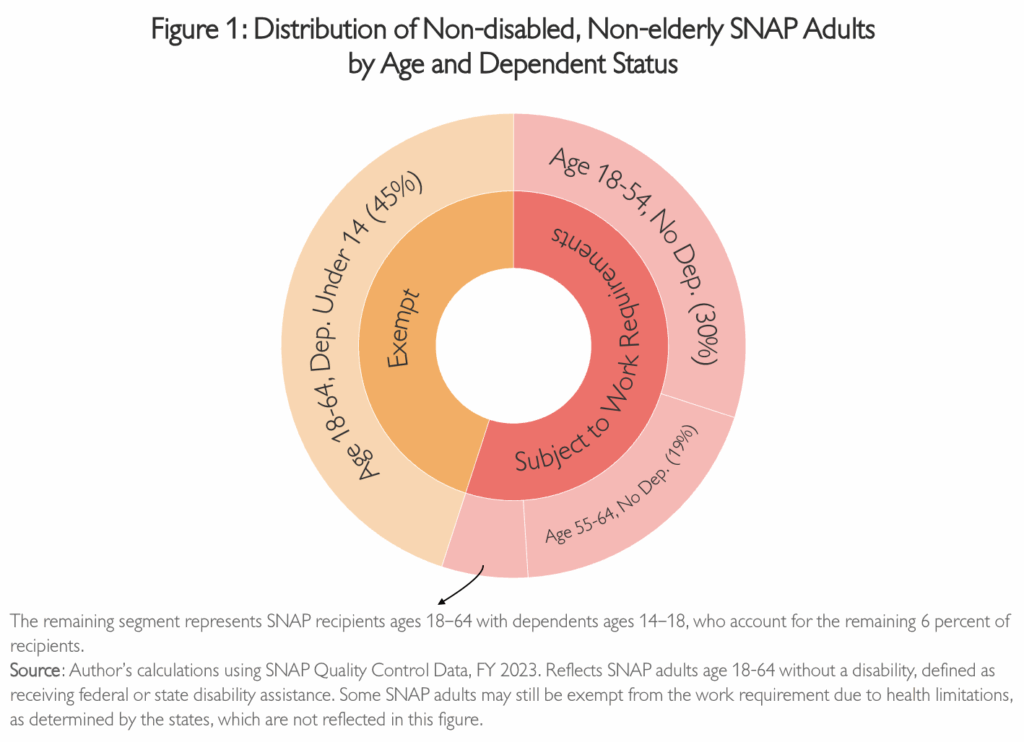
- Focusing SNAP on nutritious products. Across eighteen states, 2026 will bring changes in what participants can purchase with their benefits. Historically, SNAP allowed the purchase of any food or beverage except alcohol, tobacco, and hot prepared foods. Eighteen states requested and received approval from FNS to further restrict SNAP eligible products to address nutrition concerns.
Each state is implementing its own policy based on the waiver FNS approved. The new restrictions cover a range of products depending on the state, including soda, desserts, candy, and certain processed foods, among others. Effective dates also vary by state, with five policies taking effect on January 1, 2026 and the remainder rolling out over the course of the year. Once fully implemented, the restrictions will apply to roughly 31 percent of SNAP participants, with Texas and Florida among the largest participating states and North Dakota, Hawaii, and Idaho among the smallest. - Constraining benefit costs. In 2026, SNAP expenditure increases should continue to level off, unless the economy takes a downturn. While spending will remain well above pre-pandemic levels—largely because the Biden administration’s FNS permanently increased benefit levels in 2021 without congressional authorization, a move the GAO found improper—several recent policy changes are likely to bring costs under control. The OBBBA restricts benefit increases above inflation absent congressional approval, and FNS is expected to reissue regulations that would significantly curtail the use of broad-based categorical eligibility to expand income limits and eliminate asset tests. The Congressional Budget Office estimated that the OBBBA’s changes to SNAP (in total) would reduce expenditures by roughly $10-$15 billion per year.
- Limiting SNAP participation among non-citizens. Historically, most non-citizens who have been in the United States for fewer than five years have been ineligible for SNAP, with limited exceptions, including refugees and asylum seekers. Beginning in 2026, SNAP eligibility will be limited to lawful permanent residents who have resided in the United States for at least five years, along with some other non-citizen categories, eliminating eligibility for refugees and asylum seekers.
SNAP will undergo significant changes this year intended to reduce payment errors, support employment, improve nutrition, control spending, and better target assistance to citizen households. Implementing these changes will require substantial administrative effort by states, including updates to eligibility and data systems, staff training, and improved coordination between SNAP eligibility and workforce development programs. While these reforms will impose short-term administrative and operational burdens, over the longer term they are expected to improve program efficiency and effectiveness.