Would ending the capital gains lock-in for senior homeowners free up larger homes for families?
Summary: For senior homeowners, removing the cap entirely or retroactively inflation adjusting the current caps of $250,000 (single) and $500,000 (joint) to $500,000 (single) and $1 million (joint) would boost supply, improve affordability, and reduce market frictions:
- Lead to downsizing: senior homeowners who sell these locked-in homes would move to smaller ones.
- About 25-30% of seniors moving out of single-family homes will move into types of housing that do not compete with single-family homebuyers.
- It is estimated that hundreds of thousands of family-sized homes are sitting vacant, with heirs awaiting the death of a loved one, so as to benefit from the step-up in basis at death.
- The filtering down process would apply to the move-up buyers purchasing the homes freed up by the capital gains tax holiday.
- Nationally, about 1.9 million and 1.4 million homes with owners over the age of 65 have gains either in excess of the current applicable capital gains exclusion limit or greater than the current exclusion, but less than an exclusion of $500,000 (single) and $1 million (joint), respectively. This lock-in has kept many from selling. Additionally, upon death, one’s heirs have the basis in a home increased to current market value, thereby eliminating the tax on capital gains. This has kept many from selling.
- If over 10 years, 1/3 of these 1.9 million or 1.4 million households responded to an elimination of the capital gains lock-in constraint, this would return 600,000 and 450,000 homes to the market, thus adding 60,000 and 45,000 move-up homes per year, respectively. This would increase home sales by about 15% and 11% annually.
Question 1: What is meant by the capital gains lock-in and what is driving it?
The capital gains lock-in is the propensity of individuals to postpone selling appreciated assets subject to capital gains taxes.
This lock-in is driven by two mechanisms: a low exemption threshold and stepped-up basis upon homeowner death. The first mechanism arises from the combination of an unindexed capital gains exemption on the sale of a home and the massive amount of consumer price inflation (CPI) and home price inflation (HPI) over the ensuing period.
In 1997, the Internal Revenue Code was amended to provide a capital gains exemption of $250,000 (individual) and $500,000 (joint). These amounts were not indexed for either consumer price inflation (CPI) or home price inflation (HPI). [1]
If they had been indexed, the values in 2025 would be:
| Filer status | 1997 value (unindexed) | 2025 value (CPI) | 2025 value (HPI) |
| Single | $250,000 | $500,000 | $700,000 |
| Joint | $500,000 | $1,000,000 | $1,400,000 |
This failure to take inflation into account distorts the actual assessment of gains – a large part of what is called “capital gains” is actually just inflation. For example, a home that has doubled in value from 1997 to 2025 did not see any capital gain after adjusting for CPI, and yet would be taxed as such.
A second mechanism of lock-in is the “step-up” in basis at death. When a homeowner dies, the heir receives the property with a tax basis equal to its fair market value, eliminating the unrealized capital gains for income tax purposes.[2] This creates an incentive to hold appreciated homes rather than sell during life, since the embedded tax liability can disappear at death. Increasing the capital gains exclusion would reduce this incentive to defer selling these homes.
This lock-in penalizes millions of seniors who might otherwise sell their homes, particularly households in the following situations:
- Transitioning to assisted living and nursing homes
- Downsizing into smaller homes
- Moving to live with children or other family
- Holding onto vacant homes, particularly for millennials or Generation X, as heirs might otherwise sell their parents’ homes, but are incentivized to wait until the homeowner dies
Question 2: Is there evidence of the capital gains lock-in effect?
Strong evidence is provided by an examination of both tax expenditures and capital gains revenue relative to homes. As the chart below demonstrates, tax expenditures for the two home-related capital gains exclusions total about $100 billion per year, while gains actually recognized on home sales are relatively small at $6.5 billion per year. This large disparity indicates that most accrued housing gains are either deferred or avoided altogether, which is what one would expect in the presence of a strong lock-in effect.
| IRS Treatment | FY 2025 |
| Tax expenditure on capital gains exclusion on home sales | $61.74 billion[3] |
| Tax expenditure on capital gains exclusion on step-up basis at death | $37.83 billion[4] |
| Capital gains actually recognized on home sales | $6.5 billion[5] |
To analyze further, we conducted an original study of senior homeowners. We collected age and marriage data from 80,000 random primary homeowners of single-family homes valued at $500,000 or more, and purchased before 2016.[6] To calculate capital gains, we subtract purchase value from current value, imputing from the Federal Housing Finance Agency House Price Index (FHFA HPI) for homes purchased before 2000. To approximate unobserved capital improvements that increase tax basis (and decrease capital gains), we conservatively reduce estimated capital gains by 25%. National figures are then extrapolated from this sample.[7]
We find about 2 million homes with owners over the age of 65 exceed the applicable capital gains exclusion limit by an average of $310,000. This represents $620 billion in unrealized capital gains corresponding to an unrealized tax of $93 billion at an assumed 15% rate. The $6.5 billion in annual capital gains actually realized only amounts to 7% of the unrealized tax.
As the Congressional Research Service noted: “between rollovers, exclusions, step-up in basis (which allowed capital gains to be avoided if the home were held until death and left to heirs), and under-reporting, very little capital gains on owner-occupied housing were taxed. Thus, little revenue was gained from a set of provisions that, nevertheless, caused distortions in behavior and complicated compliance.”[8]
Question 3: Do people with taxable capital gains on their home hold on because of a very strong bequest motive?
Yes, research has shown that to be the case, specifically data on tenure at death of those aged 50+:
In 2019, there were 2.6 million deaths of persons aged 50 and older.[9]
- One million of these were renters.
- Of the 1.6 million decedents who lived in owner-occupied housing, a half million were the first-to-die spouse in a couple and transferred ownership to the surviving spouse.
- The remaining 1.1 million died as homeowners and bequeathed their homes.
- Therefore, the supply of homes that could have been made available for sale from the mortality of older Americans was 1.1 million units in 2019.
Further, as of 2014, the annual flow of housing bequests is about 4.5% or $450 billion of $10 trillion in aggregate real housing value held by home-owning Americans aged 62 and older.[10]
- The median age at death is about 81-82 years (cohort of 62 years and older).[11]
- The intention for elderly homeowners to bequest $500,000 or more was about 25% in 2014.[12]
Question 4: What are the property characteristics of senior homeowners with capital gains in excess of the applicable exclusions?
In 2022, Redfin reported that baby boomers owned twice as many large homes as millennials with kids.[13]
We use our sample of senior homeowners to identify the 1.9 million households with capital gains in excess of their exemptions.[14] As expected, this cohort of homeowners owns homes with about 2,000 square feet and 3 bedrooms.
Characteristics for the 1.1 million married senior households with more than $500,000 in excess gains:
- Median tenure: 29 years[15]
- Median living area: 2,300 square feet
- Average value: $1,522,000
- Average equity gain in excess of $500,000: $336,000
- Average number of bedrooms: 3
Characteristics for the 825,000 single senior households with more than $250,000 in excess gains:
- Median tenure: 27 years
- Median living area: 1,950 square feet
- Average value: $1,032,000
- Average equity gain in excess of $250,000: $276,000
- Average number of bedrooms: 2.7
Question 5: Is there evidence that there are older Americans who would like to downsize?
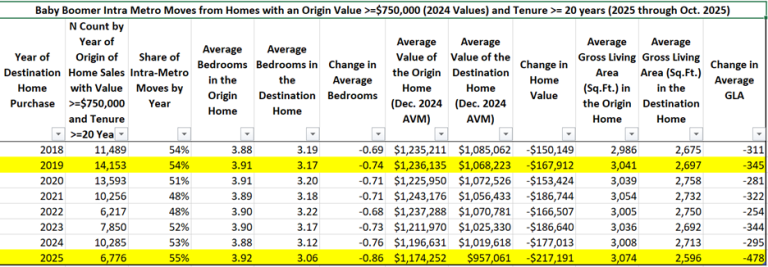
We examined the downsizing propensity of seniors who actually did move using a unique dataset going back to 2018 that tracks homeowners who have moved from an origin home to a destination home. For this analysis, we restricted moves to origin homes with a value of at least $750,000 (2024 value) and a tenure of at least 20 years (a proxy for senior owners).
We divided the groups into intra- and then inter-metro moves, which are about evenly split, and found a downsizing trend:
- For both Intra and inter metro moves, the average senior selling a high-value home moved down in terms of number of bedrooms and home value. Living area square footage changes were more varied.
For intra metro moves:
- The average number of bedrooms (origin to destination) dropped by about 0.86 bedrooms from 3.92 to 3.06 in 2025 (first graphic below).
- The origin bedroom count has been relatively stable, with the destination bedroom count trending down in recent years (second graphic below).
- Living area is consistently smaller, with a percentage decline of 11% in 2019 vs. 16% in 2025.
- These declines roughly correspond to the change in destination home value vs. the origin value (-14% for 2019 and -18% for 2025). See first table below.


For inter metro moves:
- The average number of bedrooms (origin to destination) dropped by about 0.39 bedrooms in 2025 (first graphic below).
- The origin and destination bedroom trends have been relatively stable (second graphic below).
- Living area changes relatively modestly, with the percentage decline being +3% in 2019 and -3% in 2025 (second table below).
- Destination home value declines: -31% for 2019 and -28% for 2025.
- The modest changes in living area combined with the substantial decline in destination home value vs. the origin value makes sense, as this indicates that the living area cost per square foot was less in destination metros. This allowed movers to maintain similar living area even though moving into a lower cost home.



Question 6: Is there evidence that Americans are staying in their homes for longer compared to the past?
Median homeowner tenure in recent years is at a historically high level, having almost doubled from 6.5 years in 2005 to 11.9 years in 2024, but has fallen somewhat from the 2020 peak of 13.4.

Question 7: What evidence is there that a capital gains tax holiday would boost supply and improve affordability?
- As already noted, seniors moving out of single-family homes have been downsizing, and this would continue to be the case with a capital gains tax holiday.
- One also needs to take into account filtering down, which would be at work with respect to the move-up families purchasing the homes freed up by the capital gains tax holiday. Think of the process where the sale of a new car frees up a less expensive, but still serviceable used car. The same process is operational in the housing market. See https://www.aei.org/wp-content/uploads/2024/09/Filtering-overview-Final.pdf?x85095

- Additionally, about 25% – 30% of seniors moving out of single-family homes will move to types of housing that do not compete with families buying single-family homes. This includes:
Rental: while precise data on this type of move are scarce, research on tenure upon the death of older individuals finds 38% are renters.[16] This is well above the 22% renter percentage for older individuals generally.[17]
Independent living communities: while precise data on this type of move are scarce, it appears that 3% of seniors live in independent living communities.[18]
Assisted living communities: while precise data on this type of move are scarce, it appears that 2.4% of seniors live in assisted living communities.[19]
Nursing homes: while precise data on this type of move are scarce, it appears that 4% of seniors live in nursing homes.[20]
Living with family: while precise data on this type of move are scarce, it appears that 9.3% of seniors live with family or in other co-living arrangements.[21]
Senior-only for sale communities: while data for this type of move are scarce, there are 3,000 for sale 55+ communities across the nation.[22] The largest is Florida’s The Villages with 70,000 homes.[23] In total, there are likely about 1 million such homes, with about 84,000 sales per year.[24] These homes account for about 3-4% of moves by seniors selling a home.
There would also be an undetermined number of homes that are sitting vacant, with heirs awaiting the death of a loved one, so as to benefit from the step-up in basis at death.[25] While precise data on the number of these homes are scarce, it could number in the hundreds of thousands of family-sized homes.
Question 8: What is the race/ethnic and state-by-state distribution of large capital gains that current owners likely have?
- In terms of income, these owners are asset rich (a highly appreciated home), but with retiree-type incomes.[26] Median income of homeowner households is about $55,000. Therefore, large long-term capital gains would be taxed at a much higher bracket.

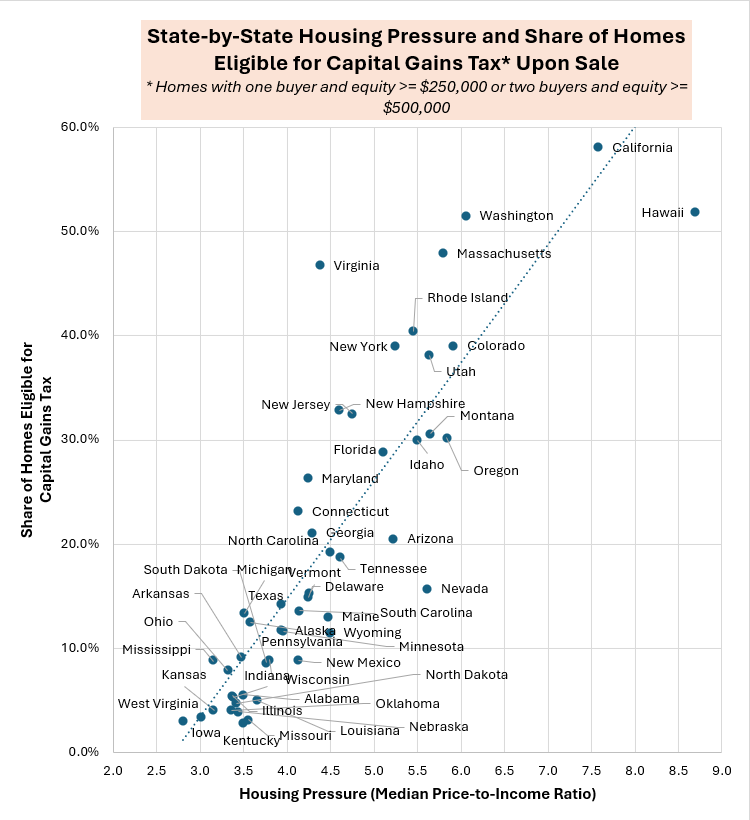
- In terms of geography, we looked at state-by-state housing pressure (median home price to median household income—all households) and the share of homes eligible for capital gains tax upon sale on homes with one buyer & equity >= $250,000 or two buyers & equity >= $500,000, as shown in the scatter plot below. It shows a strong correlation between housing pressure (median price-to-income ratio) and the share of homes eligible for capital gains in excess of the exemptions.
Question 9: How many homes might be freed up by ending or reducing the capital gains lock-in for seniors?
The current limits have not been adjusted since 1997. The resulting lock-in has kept many from selling. Consumer price inflation since 1997 has been about 100%, which indexed for inflation would yield exclusions of $500,000 (single) and $1 million (joint).
Nationally, about 1.9 million and 1.4 million homes with owners over the age of 65 have gains either in excess of the current applicable capital gains exclusion limit ($250,000 for single and $500,000 for joint) or greater than the current exclusion, but less than an exclusion of $500,000 (single) and $1 million (joint), respectively.
Additionally, upon death, one’s heirs have the basis in a home increased to current market value, thereby eliminating the tax on capital gains.
These two provisions have kept many from selling.
If over 10 years, 1/3 of these 1.9 million or 1.4 million households responded to an elimination of the capital gains lock-in constraint, this would return 600,000 and 450,000 homes to the market, thus adding 60,000 and 45,000 move-up homes per year, respectively. This would increase home sales by about 15% and 11% annually.
Since these homes already exist, they would immediately address a portion of our housing shortage, especially for move-up family households, and would set off a daisy-chain of moves (filtering down), promoting a redistribution of home sizes so that supply and demand are better matched.
Implementing this initiative would have a minimal cost in lost tax revenue, as most of the tax gains on these homes would be eliminated upon the step-up in basis available upon the death of the owner.
Question 10: Are there other economic benefits provided by a capital gains tax holiday?
Moody’s Analytics has found:[27]
“Under scenarios where housing turnover rises by 10%, or 400,000 existing-home sale transactions, in response to reduced capital gains lock-in effects, state and local transfer taxes (ranging from 0.5% to 1%) could generate an additional $800 million to $1.6 billion annually based on recent median house price data. Federal and state income taxes (averaging 25%) on realtor commissions for these sales (near 6%) could yield $2.4 billion in additional revenue.
Furthermore, local property tax bases could strengthen as homes transfer from owners with significant homestead exemptions that restricted property tax growth to owners responsible for property taxes on a stepped-up basis. These transfers could generate upwards of $1 billion in additional property tax revenue (which totaled $797 billion in 2024), especially in states like California and Florida, where provisions such as Proposition 13 and Save Our Homes, respectively, restrict property tax increases for long-time homeowners.
Income and sales tax collection stemming from additional economic activity that home sales typically generate, such as remodeling or furniture sales, could further offset revenue effects from changes to capital gains taxes on primary home sales. In addition, unlocking the housing stock could affect labor mobility, potentially enhancing productivity and taxable income.
From a cost perspective, optimizing the allocation of housing among households could alleviate strain on infrastructure and enhance the efficiency of government services, potentially resulting in substantial public expenditure savings.
Question 11: Are capital gains among seniors highly sensitive to age?
Raising the senior cutoff from 65 to 70 or 75 does not materially change average excess capital gains above the exemption – 75-year-olds have roughly the same gains as 65-year-olds.
Average capital gains (net of improvements), by minimum age cutoff, for seniors with homes worth at least $500k and who bought 10+ years ago:
- 65+: $433,968
- 70+: $437,008
- 75+: $442,066
- 80+: $450,312
Gains are higher for people 90+ ($490,000), but only 7% of senior householders fall in that age range.
Under a higher exclusion ($500k single / $1M married), the share (and count) of senior households that would become fully exempt is:
- 65+: 73% (1.4 of 1.9 million) households who would currently pay capital gains tax would become exempt.
- 70+: 73% (1.1 of 1.5 million)
- 75+: 73% (650,000 of 900,000)
- 80+: 74% (440,000 of 600,000)
The top 27% of senior homeowners who would currently be taxed for capital gain would still pay taxes if the exemption rose. Raising the cutoff from 65 to 75 reduces the number of people who would be affected without changing the share.

Overall, capital gains are driven more by tenure than age. For example, seniors who have owned their homes for 30+ years have average capital gains of $563,000, whereas seniors who have owned their homes for 10-19 years have $338,000 in capital gains.

[1] https://www.fhfa.gov/data/hpi/datasets
[2] In common-law states, typically only the decedent’s half receives a step-up; the surviving spouse’s half retains its original basis.
[3] https://home.treasury.gov/system/files/131/Tax-Expenditures-FY2026.pdf
[4] Ibid.
[5] https://www.taxnotes.com/research/federal/legislative-documents/congressional-research-service-reports/crs-analyzes-capital-gains-exclusion-primary-residences/7sx3w
[6] 80,000 is 0.6% of such homes.
[7] Data sources: First American, FHFA, Melissa
[8] https://www.taxnotes.com/research/federal/legislative-documents/congressional-research-service-reports/crs-analyzes-capital-gains-exclusion-primary-residences/7sx3w
[9] Supra. MBA
[10] https://crr.bc.edu/wp-content/uploads/2021/01/wp_2021-2_.pdf
[11] Ibid.
[12] Ibid.
[13] https://www.businessinsider.com/baby-boomers-wont-sell-homes-millennials-kids-need-housing-affordability-2024-1
[14] As specified in Question 2.
[15] For purchases before approximately 1995, we typically lack purchase year. To compute purchase year for such observations, we impute a purchase year using a probability distribution defined over 1965–1994, where the probability weight increases linearly with year.
[16] Of the 2.6 million deaths of individuals aged 50 or older in 2019, 1 million or 38% were renters. https://www.mba.org/docs/default-source/uploadedfiles/research/riha/23976_research_riha_silver_tsunami_report_wb.pdf?sfvrsn=cc034199_1
[17] https://www.census.gov/housing/hvs/data/charts/fig07.pdf
[18] https://www.retirementliving.com/how-many-americans-live-in-senior-housing#:~:text=Table_title:%20Senior%20Housing%20Occupancy%20Rates%20by%20Housing,Overall:%205.4%25%20%7C%20Independent%20living:%204.8%25%20%7C
[19] https://www.consumeraffairs.com/assisted-living/statistics.html
[21] https://www.jchs.harvard.edu/sites/default/files/reports/files/Harvard_JCHS_Housing_Americas_Older_Adults_2023.pdf
[22] https://www.55places.com/explore
[23] https://www.55places.com/florida/communities/the-villages
[24] https://www.55places.com/55-housing-market-trends?target=Total+Closed+Listings
[25] https://www.businessinsider.com/the-tax-that-incentivizes-boomers-to-die-in-their-homes-2025-12
[26] Supra. JCHS
[27] https://www.economy.com/getfile?q=C8D59392-75B0-4486-B9C4-3A6C8A01774E&app=download