The American Dream is a core promise of our nation. Politicians regularly extol the idea that each generation of Americans deserves to be better-off than their parents. Immigrants flocking to the United States are drawn to the possibilities that American life can offer-regardless of their background-if they work hard and dream big. The Declaration of Independence itself enshrines the rights to “life, liberty, and the pursuit of happiness” as a defining aspect of the American experiment.
At least in some ways, the United States has lived up to the promise of the American Dream. The nation’s economic output per capita, approximately $86,000 annually, outranks that of every other country with at least 10 million people1. The United States economy has grown faster over the past decade than the other advanced economies making up the G7-Canada, France, Germany, Italy, Japan, and the United Kingdom2. Fully 20 of the 25 largest publicly traded companies in the world are headquartered in the United States3.
In spite of the US economy’s unrivaled strength, there is growing concern that the American Dream is in trouble. A 2024 Pew Research Center survey found that 47 percent of American adults-and 60 percent of those age 18-29-believed the American Dream is no longer possible to achieve, the vast majority of whom believed it was possible in the past4. New York Times columnist David Leonhardt argued in his 2023 book, Ours Was the Shining Future, that economic well-being in the United States has stagnated for decades, imperiling the promise of the American Dream that each generation should surpass the previous one5.
Similarly, Columbia University economist Joseph E. Stiglitz argued a decade ago, in his book The Great Divide: Unequal Societies and What We Can Do About Them, that the American Dream is largely a myth6. In recent years, headlines have continued to highlight the perceived plight of younger generations of Americans, with one naming millennials “the unluckiest generation in U.S. history” and another arguing that “millennials don’t stand a chance.”7
Not all assessments of the American Dream are pessimistic. Economist Michael R. Strain of the American Enterprise Institute provides a comprehensive assessment of claims about the state of the American Dream in his book The American Dream Is Not Dead (But Populism Could Kill It). He shows that claims of the American Dream’s demise are overwrought and inconsistent with a rigorous analysis of the evidence8. Based on data from the Federal Reserve’s Survey of Household Economics and Decisionmaking, one of us (Kevin Corinth) and Jeff Larrimore note that adults from younger generations-millennials and Generation Z-report exceeding their parents’ living standards at a similar rate as baby boomers9.
Figure 1. Share of Americans Age 18–70 Who View Each Component as Essential to the American Dream, 2018
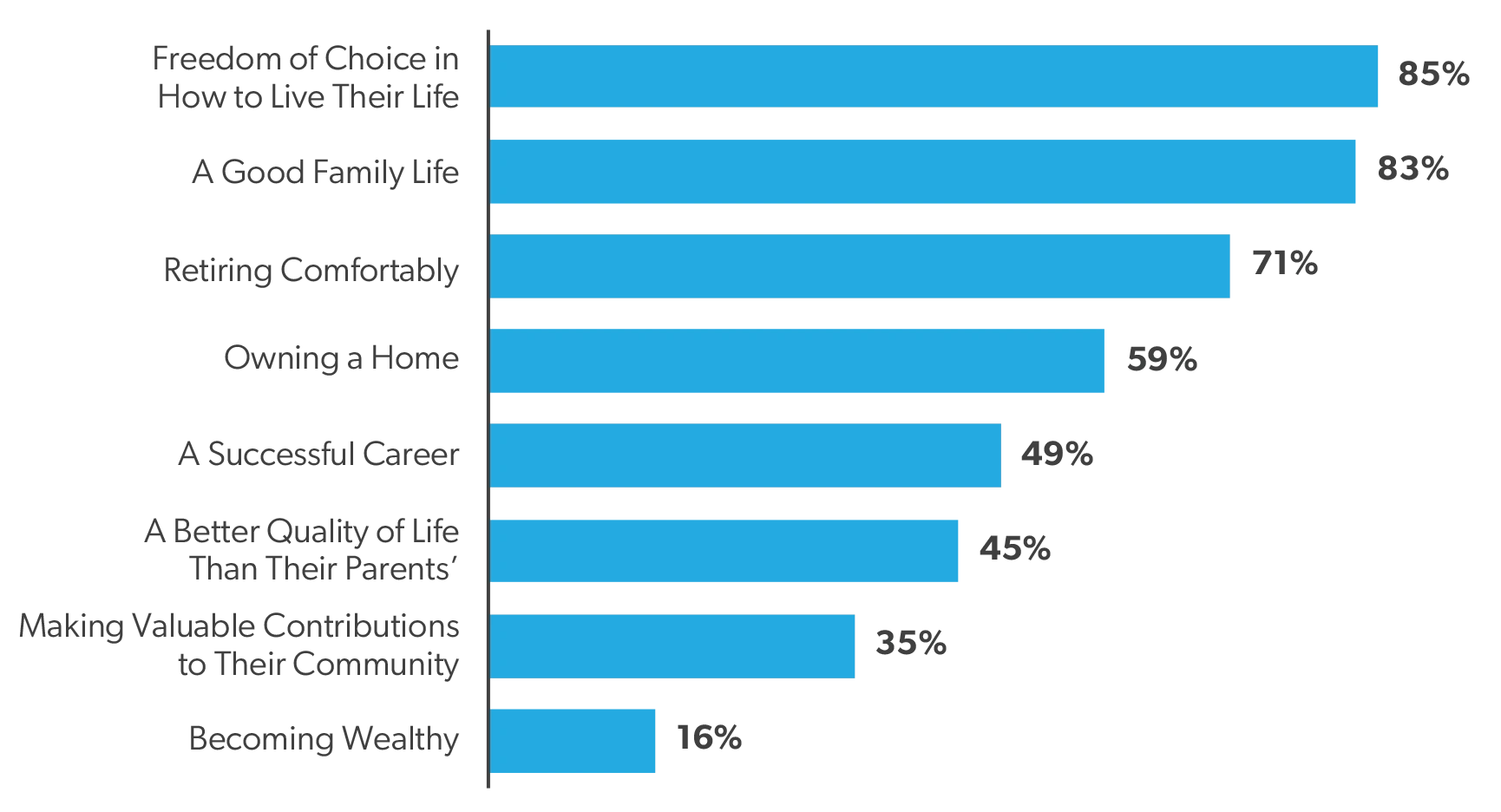
Source: Samuel J. Abrams et al., AEI Survey on Community and Society: Social Capital, Civic Health, and Quality of Life in the United States, American Enterprise Institute, February 5, 2019, 30, fig. 22, https://www.aei.org/research-products/report/aei-survey-on-community-and-society-social-capital-civic-health-and-quality-of-life-in-the-united-states/
Although the American Dream is widely discussed and debated, it has no universally agreed-on definition. In different contexts, it has referred to the relative economic improvement of each generation over the previous one, the attainment of markers of well-being such as homeownership, and a broader conception that focuses on economic and noneconomic factors. It is this broader notion of the American Dream that resonates most with Americans.
A 2019 survey by the American Enterprise Institute asked a nationally representative sample of respondents to indicate the most essential components of the American Dream. Many respondents included milestones associated with economic well-being, including retiring comfortably (71 percent), owning a home (59 percent), having a successful career (49 percent), having a better quality of life than their parents (45 percent), and becoming wealthy (16 percent). However, noneconomic factors were arguably just as important, including the freedom of choice in how to live their life (85 percent), having a good family life (83 percent), and making valuable contributions to their community (35 percent)10. (See Figure 1.)
In this handbook, we take a broad view of the American Dream because focusing strictly on economic elements would omit half the story. Americans would not view a society that delivered strong economic prosperity without social prosperity as a success. This chapter assesses the state of the American Dream, broadly defined, on economic and social dimensions. The handbook’s following chapters show how public policy can strengthen the American Dream across all its dimensions.
Economic Well-Being
We begin by assessing the economic components of the American Dream across several measures. With some important exceptions, the economic side of the American Dream is alive and well.
One simple test of the American Dream’s economic strength is whether American incomes have grown over time. The Congressional Budget Office (CBO) reports trends in a comprehensive measure of income that adjusts for taxes and includes transfers. According to the CBO, inflation-adjusted income among households in the middle three quintiles (i.e., excluding the poorest 20 percent and richest 20 percent) increased by 60 percent from 1979 to 2019. Inflation-adjusted incomes in the bottom quintile increased by 97 percent, and incomes in the top quintile increased by 124 percent11. Although incomes at different parts of the distribution grew at different rates, the entire distribution has experienced substantial gains. And while some of the improvement is a result of increased transfers from a growing safety net, income before accounting for taxes and transfers grew as well among non-elderly households since 1979-by at least 40 percent for each quintile among households with children and at least 45 percent for each quintile among non-elderly households without children12.
Because the American Dream is often associated with moving up from the lowest rungs of the socioeconomic ladder, it is worth zeroing in on progress for the lowest-income Americans in terms of changes in poverty over time. The official poverty rate has barely budged in the past half century, inching down from 11.2 percent in 1974 to 10.6 percent in 202413. However, the official poverty measure suffers from widely recognized shortcomings that make it a flawed barometer for assessing poverty trends.
Richard V. Burkhauser and coauthors correct these shortcomings-they hold the poverty line constant in real terms and count all the resources that flow to low-income Americans-and they find that poverty has fallen by over 90 percent since 1963, the outset of President Lyndon Johnson’s War on Poverty14. When alternatively measuring poverty based on how much Americans consume, Jeehoon Han and coauthors similarly find that poverty has fallen by approximately 90 percent since the early 1960s15. Trends in poverty based on income and consumption are corroborated by other markers of well-being for low-income Americans such as housing quality, which show substantial improvements over the past several decades16.
An alternative approach to assessing the American Dream’s economic strength is to compare the well-being of each generation with the well-being of previous ones. One of us (Corinth) and Larrimore find that each generation of Americans, from the Silent Generation (born in 1928-45) to millennials (born in 1981-96), had a higher median income than the preceding generation at age 36-4017. While they find that intergenerational progress has slowed somewhat, the slowdown is a result of stagnating work hours since the turn of the century. Whereas the growth of female labor force participation-first among married women as societal expectations evolved in the latter half of the 20th century and then among single mothers as a result of welfare reform in the 1990s-drove household income gains until around 2000, it has since stalled and thus no longer provides an extra boost to intergenerational income growth.
When holding work hours constant, Corinth and Larrimore find that millennials and Generation X experienced more income growth than baby boomers did18. And while it is true that college costs are higher for younger generations, these costs offset only a small fraction of income gains for college graduates in each generation. In an earlier and complementary analysis, Jeremy Horpedahl finds a similar story for trends in wealth-the net value of assets held by members of each generation. By their late 20s, millennials’ and Gen Zers’ wealth outpaces that of Generation X at the same age19.
In a related exercise, Raj Chetty and coauthors come to a different conclusion when comparing the income of adults age 30 with the incomes of their parents when they were the same age. The authors document a sharp decline in the share of adults outperforming their parents, falling from around 90 percent for individuals born in 1940 to around 50 percent for individuals born in the early 1980s20.
However, one of us (Scott Winship) shows that the downward trend in absolute mobility is overstated. When accounting for all income sources, adjusting for shrinking household sizes over time, and using a more accurate inflation measure, he finds that the share of individuals outperforming their parents was still 70-75 percent for Americans born in the early 1980s21. Ideally, an even larger share of children would outperform their parents, but 70-75 percent is a lot better than one-half. Moreover, many people who do worse than their parents did at the same age are nevertheless better-off than the typical person in previous generations because economic growth raises the entire income distribution.
Across the distribution, Americans are materially better-off today than at any time in history. But economically speaking, there are still holes in the American Dream, specifically when it comes to opportunity. A central promise of America is that with hard work, anyone from any background can succeed and make a good life. However, opportunity is not equally distributed geographically or across demographic groups.
The Opportunity Atlas, published by Opportunity Insights, assembles data from the universe of tax filings for several decades in the United States, allowing us to assess whether where children grow up matters for their economic outcomes as adults22. The Opportunity Atlas shows that for a child who grows up at the 25th percentile of the income distribution, the neighborhood in which they grow up matters a lot. For example, children who grew up in many Midwestern counties have average incomes ranging from about $40,000 to $50,000 as adults, while children who grew up in many Southeastern counties have average adult incomes below $30,000. Neighborhoods with higher rates of employment and two-parent married families are associated with substantially higher earnings of children once they reach adulthood23. In other words, low-income kids who grow up in areas with low levels of work and where single parenthood is the norm have a much lower chance of economic success than low-income kids who grow up in areas with high rates of employment and marriage.
Racial disparities have similarly frustrated the American promise of equal opportunity. Winship and coauthors compare the persistence of relative poverty (defined as being in the bottom income quintile) for black and white Americans. They find that only 1 percent of white children are in poverty themselves, had a parent in poverty, and had a grandparent in poverty. The same is true for 21 percent of black children24. In other words, intergenerational poverty is about 20 times more likely for black children than white children, suggesting that it is much more difficult for black children than white children to rise out of poverty25.
Finally, even as economic growth has increased Americans’ prosperity across the distribution, improvements have increasingly come in the form of government transfers as opposed to earnings for some populations. Over the past several decades, a growing share of men have become disconnected from work, and among working low-skilled men, earnings have stagnated26. Burkhauser and coauthors show that the share of working-age Americans dependent on government for at least half their income has more than doubled since the late 1960s27.
However, they also show that during the 1990s and the period following the Great Recession, dependency fell at the same time poverty fell. This suggests that policies encouraging work-such as welfare reform in the 1990s and the eventual reinstating of work requirements for transfer programs after the Great Recession-together with a strong economy can make low-income Americans better-off without making them more dependent on government. Greater investment in skill formation, strengthened work requirements in transfer programs, and strong economic growth are required to expand opportunity to more Americans and reduce dependence on government.
In sum, the evidence paints a mostly optimistic picture of the economic side of the American Dream. However, the ideal of equal opportunity remains elusive, and more work needs to be done to help Americans achieve prosperity through self-sufficiency as opposed to government dependency.
Social Well-Being
The social side of the American Dream is in worse shape. Declining social well-being can be seen in the weakening American family, detachment from communities, and erosion of social trust.
One lens through which to view the decline of social well-being in the United States is a concept called social capital. Social capital refers to the value of relationships an individual has with others, including family, community and religious organizations, and social institutions. Robert Putnam, in his 2000 book, Bowling Alone: The Collapse and Revival of American Community, popularized the concept by documenting the weakening of communities in the United States. A concrete image of the decline in social capital was the transition of the bowling alley as a societal institution that used to bring people in a community together into a place where individuals bowled alone28.
More recently, the United States Congress’s Joint Economic Committee produced a comprehensive assessment of the state of social capital across the country and how it has evolved over time. It showed that many of the alarming trends published in Putnam’s book two decades earlier had continued29. The committee also produced a new county-level index that showed the large disparities in social capital across the country, with the highest levels of social capital generally in the Midwest and lowest levels in the Southeast30. Later research from Opportunity Insights, leveraging a trove of social network data from Facebook, affirmed the geographic patterns established by the Joint Economic Committee and further linked variation in social capital with economic mobility31. Not only does low social capital directly impede social outcomes that people care about, but it makes economic outcomes more difficult to achieve as well.
One of the most important aspects of social well-being is having a strong family, which 83 percent of Americans report as being an essential component of the American Dream. A strong family begins with a strong marriage. Unfortunately, marriage is in decline. Among individuals age 15 and over, the share who are married fell from 67 percent in 1950 to 51 percent in 202432. Marriage is especially important when raising children, but the share of children in single-parent families grew from 9 percent in 1960 until peaking at 28 percent in 199733.
Since then, the growth in single parenthood stopped, in conjunction with welfare reform in the 1990s that encouraged reliance on work and marriage as opposed to welfare for low-income mothers, with the share of children in single-parent families falling slightly to 25 percent by 2024. While the trend has not worsened, it remains alarmingly high, especially for children from historically disadvantaged populations. Fully 69 percent of newborn black children and 53 percent of newborn Hispanic children were born to unmarried mothers in 202234. Children born outside a married family start off with a major social capital deficit.
In addition to the falling share of children living with married parents, another concerning trend is that the number of children born each year is falling. In 2024, 3.6 million babies were born, only slightly above the lowest level this century, which was recorded in 202335. The decline in fertility has important implications for social capital, as it reduces the number of familial relationships each individual has. Adults have fewer children, children have fewer siblings and cousins, and aunts and uncles have fewer nieces and nephews. Smaller kin networks can reduce the developmental support provided to children as they grow up, reduce the supportive relationships available to adults as they enter the workplace and begin new families of their own, and deprive the elderly of familial care options.
In a Joint Economic Committee report, Rachel Sheffield projects that as a result of the decline in fertility in recent decades, the share of 75-year-olds who are childless will grow from 24 percent in 2022 to 42 percent in 206136. Fewer Americans will have family to depend on as they age, and more Americans will die old and alone. Weaker and smaller families today have consequences that will persist long into the future.
Beyond the family, strong communities and social institutions have traditionally been an important source of social capital, through informal relationships with neighbors and friends, as a source of purpose and deep personal connections in religious organizations, and via the sense of stability and reliable information provided by trusted civic institutions like the media and governmental bodies. Though trends on these dimensions are more difficult to track, some of these forms of social capital appear to be in decline as well. The share of Americans attending religious services fell from 56 percent in 1972 to 48 percent in 202237. Moreover, the share who never attend religious services increased from 10 percent to 34 percent over the same period. Individuals also rely less on neighbors and place less trust in institutions of civil society38. The exceptions to the general decline in social capital are relatively stable trends in volunteering and connections with friends39.
The most extreme symptoms of the broad decline in social capital have taken a major toll on American families and the health of our society. “Deaths of despair” have grown to unprecedented levels. In 2023, approximately 105,000 people died of a drug overdose in the United States, a staggering toll that does not begin to account for the societal costs imposed by drug abuse that does not end in fatality40. Provisional data suggest that overdose deaths fell in 2024 but remain at historically unprecedented levels41. Approximately 49,000 people died from suicide in 202342. Meanwhile, disconnection has enabled increased polarization of society, including on political grounds. These phenomena are surely multicausal, but the decline of social capital likely has played a role.
Strengthening the American Dream
The American Dream is a bedrock of American society. It represents some of the highest ideals for humanity, and historically, it has lived up to its billing. But the American Dream-broadly defined-is in trouble. Economically speaking, the United States is unrivaled in its prosperity among major countries, delivering rising living standards to all its citizens. The economic half of the American Dream is very much alive. However, major disparities in opportunity remain, and the long-term slowdown of economic growth and recent rise in the cost of living leave Americans of all walks of life worse off than they might be.
As for the social half of the American Dream, it should be setting off alarm bells. The most fundamental unit of society-the family-is in peril, and communities have weakened. Without social prosperity, American society’s economic success will feel insufficient, and confidence in the American Dream will wane.
It is this handbook’s project to put the American Dream back on track. While the handbook emphasizes the role of government policy, and especially federal policy, we recognize that government is not the only, or even primary, solution. Making the American Dream stronger than ever will require efforts by individuals within their own families, communities, and broader civil society. It will take time, but the work can start only when we correctly diagnose the problems and when government policy stops working against progress and instead helps move it forward.
The handbook begins with a chapter on how we can strengthen economic growth. Veronique de Rugy dispels the notion that we must accept a lack of growth and innovation, arguing instead that economic growth is fundamental to lowering poverty, increasing the standard of living, and reducing our ever-increasing national debt. She shows how heavy regulations and distortive taxes have led to stagnated productivity and advocates a pro-growth agenda centered on deregulation, reforming the tax code, and promoting free trade.
In his chapter on reducing the cost of living, Paul Winfree chronicles the rising cost of childcare, housing, and other important resources for families. He argues that a continued reliance on demand-side subsidies will fail to bring these costs down. A better approach would involve increasing competition by relaxing regulations and committing to fiscal discipline to keep inflation low.
The handbook then switches gears with a chapter on how we can more productively invest in our workforce. Brent Orrell and Mason M. Bishop emphasize the importance of building resiliency and generalizable skills in American workers as artificial intelligence and other technological innovations disrupt the labor market. They propose expanding sector-based training, consolidating government workforce training and social service programs, and cutting unnecessary occupational licensing requirements, among other commonsense reforms.
Turning to the education system, Frederick M. Hess and Michael Q. McShane recommend reforms to early childhood, K-12, and higher education. Forcing costly regulations on early childhood providers and imposing strict requirements on families isn’t the answer. Instead, policy should support a variety of childcare options through state-based education savings accounts, which should be made available for families to choose the appropriate K-12 provider for their children, to maximize educational choice. They also recommend unburdening higher education from its growing bureaucracy by eliminating the accreditation model and increasing accountability by focusing on student labor market outcomes.
Matt Weidinger and Angela Rachidi explain how to design an opportunity-focused safety net. Our complex and duplicative welfare system costs over $1 trillion annually and discourages work and marriage-inadvertently stunting upward mobility43. They propose creative ways to streamline programs, establish more concrete work requirements, and eliminate marriage penalties to ensure better outcomes for families.
The final three chapters in the handbook shift the focus to our social ills and how we can usher in a more prosperous society. Ja’Ron Smith reviews the evidence on the economic and psychological impacts of crime at a time when Americans are increasingly concerned about public disorder. Outdated and unjust “lock ’em up” policies on the one hand and a tone-deaf “defund the police” ideology on the other are ineffective and unpopular. A “smart on crime” agenda can reduce crime at a lower cost by properly funding and expanding the police in areas of need and improving ex-felon outcomes after incarceration through probation and parole reforms.
Turning to the fundamental unit of society, the family, Robert VerBruggen documents married parenthood’s decline over the past several decades and the evidence that parents really do matter for child outcomes. He then shows how government policy can stop penalizing marriage through reforms to the tax code and transfer programs while emphasizing that a cultural shift toward prioritizing married parenthood is essential.
Finally, the last chapter focuses on repairing our social fabric. Trust in our civic institutions has declined dramatically in the past several decades. Loneliness is on the rise, polarization is rampant, and suicides and drug overdoses have pushed up mortality rates. Winship and Thomas O’Rourke explain how we can start to repair the social fabric by relaxing regulations and government programs that keep people apart and confronting problems with social media and mental health. These are essential steps for ensuring that the American Dream, broadly defined, is attainable for all.
Notes
- See World Bank Group, “GDP Per Capita (Current US$),” accessed October 6, 2025, https://data.worldbank.org/indicator/NY.GDP.PCAP.CD.
- Authors’ calculations based on World Bank Group, GDP (Constant 2015 US$), accessed October 6, 2025, https://data.worldbank.org/indicator/NY.GDP.MKTP.KD. Economic growth is defined as the percentage change in gross domestic product in real US dollars. Comparisons are made relative to 2024, the most recent year with available data.
- See CompaniesMarketCap, “Largest Companies by Marketcap,” accessed October 6, 2025, https://companiesmarketcap.com.
- Gabriel Borelli, “Americans Are Split over the State of the American Dream,” Pew Research Center, July 2, 2024, https://www.pewresearch.org/short-reads/2024/07/02/americans-are-split-over-the-state-of-the-american-dream.
- David Leonhardt, Ours Was the Shining Future: The Story of the American Dream (Random House, 2024).
- Joseph E. Stiglitz, The Great Divide: Unequal Societies and What We Can Do About Them (W. W. Norton, 2015).
- Andrew Van Dam, “The Unluckiest Generation in U.S. History,” The Washington Post, June 5, 2020, https://www.washingtonpost.com/business/2020/05/27/millennial-recession-covid; and Annie Lowrey, “Millennials Don’t Stand a Chance,” The Atlantic, April 13, 2020, https://www.theatlantic.com/ideas/archive/2020/04/millennials-are-new-lost-generation/609832.
- Michael R. Strain, The American Dream Is Not Dead (but Populism Could Kill It) (Templeton Press, 2020).
- Kevin Corinth and Jeff Larrimore, “Has Intergenerational Progress Stalled? Income Growth over Five Generations of Americans” (working paper, American Enterprise Institute, February 2024), https://www.aei.org/research-products/working-paper/has-intergenerational-progress-stalled-income-growth-over-five-generations-of-americans/.
- Samuel J. Abrams et al., AEI Survey on Community and Society: Social Capital, Civic Health, and Quality of Life in the United States, American Enterprise Institute, February 5, 2019, 30, fig. 22, https://www.aei.org/research-products/report/aei-survey-on-community-and-society-social-capital-civic-health-and-quality-of-life-in-the-united-states.
- Congressional Budget Office, The Distribution of Household Income, 2019, November 2022, https://www.cbo.gov/system/files/2022-11/58353-HouseholdIncome.pdf. Posttax, post-transfer income growth from 1979 to 2021 was even higher: 132 percent for the bottom quintile, 73 percent for the middle three quintiles, and 167 percent for the top quintile, though the higher growth rates largely reflect the unprecedented government aid in 2021 in response to the COVID-19 pandemic.
- Estimates are from Congressional Budget Office, Table Builder, https://www.cbo.gov/publication/60341.
- Emily A. Shrider and Christina Bijou, Poverty in the United States: 2024, US Census Bureau, September 2025, 22-23, table A-3, https://www.census.gov/content/dam/Census/library/publications/2023/demo/p60-280.pdf.
- Richard V. Burkhauser et al., “Evaluating the Success of the War on Poverty Since 1963 Using an Absolute Full-Income Poverty Measure,” Journal of Political Economy 132, no. 1 (2024): 1-47, https://www.journals.uchicago.edu/doi/abs/10.1086/725705.
- Jeehoon Han et al., Annual Report on U.S. Consumption Poverty: 2022, December 6, 2023, https://sites.nd.edu/james-sullivan/files/2023/12/2022-Consumption-Poverty-Report_12_12_2023.pdf.
- Bruce D. Meyer, “Consumption and Comprehensive Income Poverty,” PowerPoint presentation, Federal Economic Statistics Advisory Committee, Suitland, MD, June 14, 2019, https://apps.bea.gov/fesac/meetings/Meyer%20Presentation%20Revised.pdf.
- Corinth and Larrimore, “Has Intergenerational Progress Stalled?”
- Corinth and Larrimore, “Has Intergenerational Progress Stalled?”
- Jeremy Horpedahl, “Young People Have a Lot More Wealth Than We Thought,” Economist Writing Every Day, January 24, 2024, https://economistwritingeveryday.com/2024/01/24/young-people-have-a-lot-more-wealth-than-we-thought.
- Raj Chetty et al., “The Fading American Dream: Trends in Absolute Income Mobility Since 1940,” Science 356, no. 6336 (2017): 398-406, https://www.science.org/doi/10.1126/science.aal4617.
- Scott Winship, Economic Mobility: A State-of-the-Art Primer, Archbridge Institute, March 2017, https://www.archbridgeinstitute.org/wp-content/uploads/2017/04/Contemporary-levels-of-mobility-digital-version_Winship.pdf; and Scott Winship, “The American Dream Is Not a Coin Flip, and Wages Have Not Stagnated,” Civitas Outlook, February 20, 2025, https://www.civitasinstitute.org/research/the-american-dream-is-not-a-coin-flip-and-wages-have-not-stagnated.
- Harvard University, Opportunity Insights and US Census Bureau, Opportunity Atlas, https://www.opportunityatlas.org.
- Raj Chetty et al., “The Opportunity Atlas: Mapping the Childhood Roots of Social Mobility,” The American Economic Review 116, no. 1 (2026): 1-51, https://www.aeaweb.org/articles?id=10.1257/aer.20200108.
- Scott Winship et al., Long Shadows: The Black-White Gap in Multigenerational Poverty, American Enterprise Institute and Brookings Institution, June 10, 2021, https://www.aei.org/research-products/report/long-shadows-the-black-white-gap-in-multigenerational-poverty.
- Scott Winship et al., The Inheritance of Black Poverty: It’s All About the Men, Brookings Institution, March 22, 2018, https://www.brookings.edu/articles/the-inheritance-of-black-poverty-its-all-about-the-men/.
- For a comprehensive study of the declining rate of work among working-age men, see Nicholas Eberstadt, Men Without Work: Post-Pandemic Edition (Templeton Press, 2022). For a detailed assessment of trends in worker pay, including among men, see Scott Winship, Understanding Trends in Worker Pay over the Past 50 Years, American Enterprise Institute, May 14, 2024, https://www.aei.org/research-products/report/understanding-trends-in-worker-pay-over-the-past-50-years.
- Burkhauser et al., “Evaluating the Success of the War on Poverty Since 1963 Using an Absolute Full-Income Poverty Measure.”
- Robert D. Putnam, Bowling Alone: The Collapse and Revival of American Community (Simon & Schuster, 2000).
- US Congress, Joint Economic Committee, Social Capital Project, What We Do Together: The State of Associational Life in America, May 2017, https://www.jec.senate.gov/public/_cache/files/6f670ee8-74de-497a-85f6-4cf6502d52d4/1-17-what-we-do-together.pdf.
- US Congress, Joint Economic Committee, Social Capital Project, The Geography of Social Capital in America, April 2018, https://www.jec.senate.gov/public/_cache/files/e86f09f7-522a-469a-aa89-1e6d7c75628c/1-18-geography-of-social-capital.pdf.
- Raj Chetty et al., “Social Capital I: Measurement and Associations with Economic Mobility,” Nature 608, no. 7921 (2022): 108-21, https://www.nature.com/articles/s41586-022-04996-4.
- Authors’ calculations based on US Census Bureau, “Table MS-1. Marital Status of the Population 15 Years Old and Over, by Sex, Race and Hispanic Origin: 1950 to Present,” November 2024, https://www.census.gov/data/tables/time-series/demo/families/marital.html.
- US Census Bureau, “Table CH-1. Living Arrangements of Children Under 18 Years Old: 1960 to Present,” November 2024, https://www.census.gov/data/tables/time-series/demo/families/children.html.
- Michelle J. K. Osterman et al., Births: Final Data for 2022, Centers for Disease Control and Prevention, National Center for Health Statistics, April 4, 2024, https://www.cdc.gov/nchs/data/nvsr/nvsr73/nvsr73-02.pdf.
- Brady E. Hamilton et al., Births: Provisional Data for 2024, Centers for Disease Control and Prevention, National Center for Health Statistics, April 2025, https://www.cdc.gov/nchs/data/vsrr/vsrr038.pdf.
- Rachel Sheffield, The Consequences of Declining Fertility for Social Capital, US Congress, Joint Economic Committee, Social Capital Project, December 2022, https://www.jec.senate.gov/public/_cache/files/635c69dc-6a5a-467b-b7b0-3ab906fb4a94/the-consequences-of-declining-fertility-for-social-capital.pdf.
- NORC at the University of Chicago, General Social Survey Data Explorer, “How Often Respondent Attends Religious Services,” accessed July 12, 2024, https://gssdataexplorer.norc.org/trends.
- US Congress, Joint Economic Committee, Social Capital Project, What We Do Together: The State of Associational Life in America, May 2017, https://www.jec.senate.gov/public/_cache/files/6f670ee8-74de-497a-85f6-4cf6502d52d4/1-17-what-we-do-together.pdf.
- US Congress, Joint Economic Committee, Social Capital Project, What We Do Together.
- Matthew F. Garnett and Arialdi M. Minino, Drug Overdose Deaths in the United States, 2003-2023, Centers for Disease Control and Prevention, National Center for Health Statistics, December 2024, https://www.cdc.gov/nchs/data/databriefs/db522.pdf.
- Centers for Disease Control and Prevention, “CDC Reports Nearly 24% Decline in U.S. Drug Overdose Deaths,” press release, February 25, 2025, https://www.cdc.gov/media/releases/2025/2025-cdc-reports-decline-in-us-drug-overdose-deaths.html.
- Centers for Disease Control and Prevention, “Suicide Data and Statistics,” March 26, 2025, https://www.cdc.gov/suicide/facts/data.html.
- Office of Management and Budget, “Table 8.6-Outlays for Mandatory and Related Programs in Constant (FY 2017) Dollars: 1962-2029,” https://www.whitehouse.gov/omb/budget/historical-tables/.