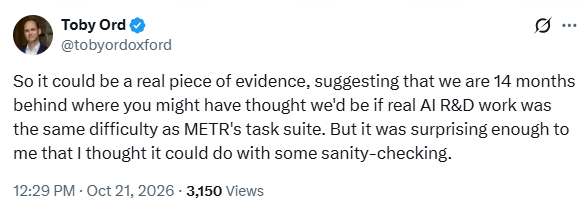
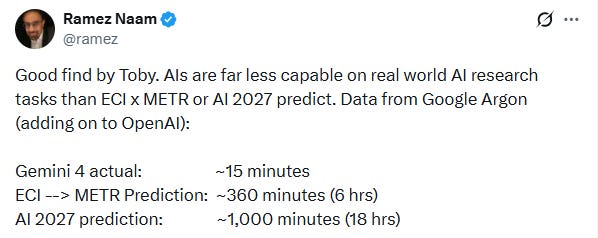
Self-improving AI—a potential advance that typically plays a starring role in speculation about an impending “intelligence explosion”—might not arrive as soon as some enthusiastic technologists have been predicting. At least that’s my takeaway (well, one of two) from an X debate between Oxford existential-risk philosopher Toby Ord (author of The Precipice), clean-energy investor and futurist Ramez Naam, and others over new internal data from OpenAI and Google.
Both labs measured how long their AI models can perform actual internal AI R&D tasks with roughly 80 percent reliability. The basic intuition here is that the longer these models can operate at a high, human-like level, the more useful businesses and research institutions will find them. Assuming that intuition is correct, the R&D results were pretty underwhelming. The models managed just 15 minutes of human-equivalent work, far short of the three-hour horizon that’s been seen on public benchmarks.
If you’re AGI-pilled and counting on supersmart AI “changing everything” really soon—at least through the capabilities flywheel of recursive self-improvement—this isn’t a result you will find encouraging. It points more to AI still functioning as a research assistant rather than as the research lead (which of course can still be an important and helpful use case).
The panic should subside
My second takeaway is that this result is another data point about where we are in the AI Revolution, particularly concerning the chasm between lab capabilities and real-world usefulness. It’s a gap that helps explain the findings of a new Goldman Sachs analysis, “Revisiting the Extent and Timing of AI Labor Displacement.” For all the concern about a looming “white-collar bloodbath” in the American labor market—concern no doubt driving current pessimism toward AI and hostility toward the AI data center buildout—that collapse isn’t happening.
This from the bank (bold by me):
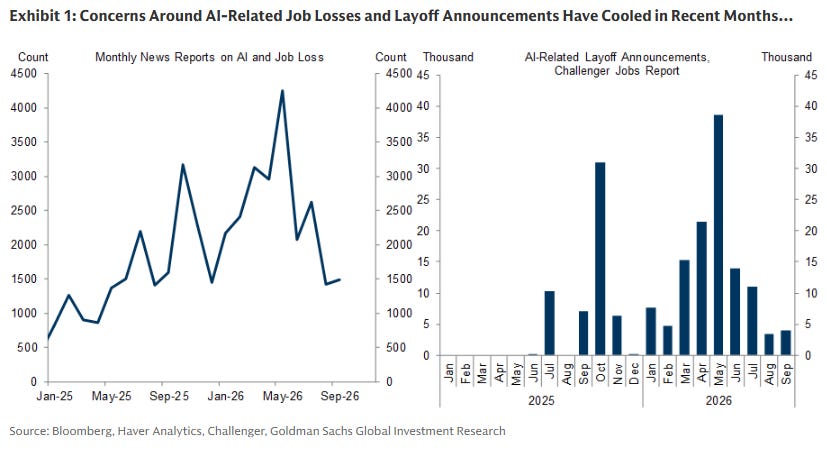
Concerns of imminent AI-related labor displacement have cooled in recent months after hitting a fever pitch this spring. As shown in Exhibit 1, the number of layoffs attributed to AI has pulled back sharply from its peak this spring. On a similar note, the number of news reports on AI-related job losses surged through May but has since fallen back to levels seen at the start of 2026.
As we noted in our most recent AI adoption tracker, the labor market impacts from AI remain visible but narrow. Job growth in the most AI-exposed industries continues to underperform by around 10k relative to its long-run trend over the last 3 months (consistent with the underperformance over the last several years), although this has been roughly offset by increased hiring in AI-related construction jobs.
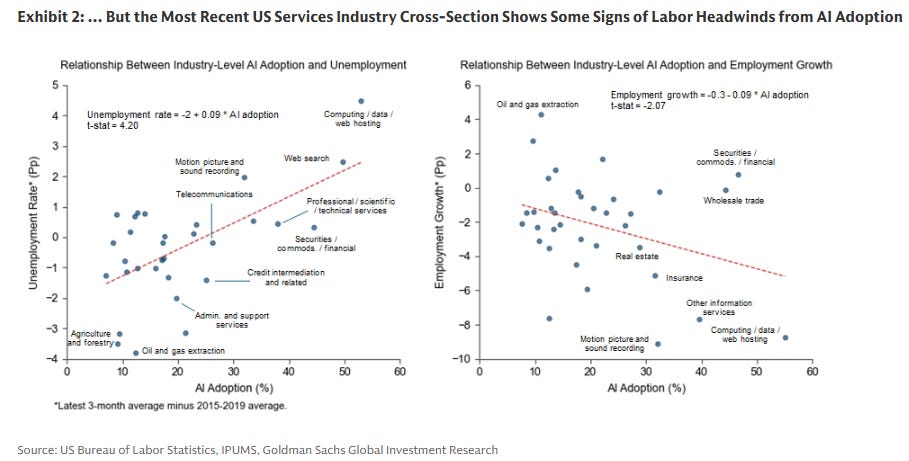
Cross-sectional industry-level patterns are starting to show some signs of AI-related hiring headwinds from AI adoption, however. As shown in Exhibit 2, the correlation between adoption and unemployment has turned positive (and statistically significant) in the service sector, while the correlation between AI adoption and job growth has turned slightly negative (albeit not statistically significant). While these patterns suggest that a modest labor market headwind is emerging, the near-term headwinds remain smaller than feared earlier this year.
As a result, the AI-labor market discussion has started to shift from whether large job losses are imminent to whether AI labor cost savings will be sufficient to justify rising AI investment. As noted by our US portfolio strategy team, current capex projections imply that AI users will need to spend roughly $1 trillion annually on AI applications for hyperscalers and application providers to generate the profits which markets appear to be discounting.
Let me emphasize this part of that quote: “The AI-labor market discussion has started to shift from whether large job losses are imminent to whether AI labor cost savings will be sufficient to justify rising AI investment.”
Economic history (it took years, even decades, for past general-purpose technologies to deliver big productivity gains) and economic theory (expect productivity stagnation or even a dip as firms reorganize around a new technology) win again. The economic upsides of AI will take time to emerge, and it’s still so, so early.
Whatever happens in the lab, the real world is messy. That reality shows up in the underwhelming R&D metrics mentioned above, and in how businesses still struggle to put AI to productive use. Most companies, while eager and optimistic, haven’t yet figured out how to deploy AI deeply and reliably enough to reorganize their operations. When that happens—and I’m confident it will—some jobs will disappear even as new tasks, roles, businesses, and sectors emerge.
Timing is everything
Still, this adoption hurdle isn’t the only factor at play. As the bank further notes, the AI Revolution is unfolding during an economic expansion, and its research suggests “automation-related labor disruption is limited when the overall economy is healthy but accelerates during cyclical slowdowns.” More good reason for Washington to conduct smart fiscal and monetary policy.
The Fed and other central banks should therefore remain attuned to any emerging downside growth or labor market risks once the near-term inflation constraint is lifted, since a quick pivot to easing could help ensure that automation-related job losses do not accelerate at a time when the economy is ill-equipped to create the new jobs necessary to support a smooth AI transition.
The long-run jobs math
Keep in mind that the bank’s baseline forecast is that AI will cause substantial job disruption over time, affecting roughly 9 percent of the labor force, or 15 million workers, over a ten-year adoption cycle. To be clear, that doesn’t mean a 9 percent unemployment rate. Workers can and will find new jobs, including those created by AI. If losses are spread over a decade and most people find new work within a year, the unemployment rate rises by less than 1 percentage point under Goldman’s forecast.
Key to this view is our expectation that over the long run AI will create many new jobs even as it destroys existing ones. Historical evidence provides support for this view. As we’ve noted, technology has been a key driver of long-run job growth. About 60% of workers today are in occupations that didn’t exist in 1940, which account for 85% of the job growth since then. The US economy creates 25-35mn gross new jobs in a typical year. Most importantly, the US labor market is incredibly dynamic. Although the US economy adds a few million net jobs per year at most—well below the annual AI-related job losses that we anticipate during the transition—this number is the difference between much larger gross job gains (defined as net job gains at expanding and opening establishments) and gross job losses (defined as net job losses at expanding and closing establishments). These gross measures have historically fluctuated between 25 and 35mn per year, implying that the economy is constantly creating and destroying jobs, even during normal times. In a dynamic AI-enabled economy, it is quite plausible that a moderate step-up in the pace of job creation will boost gross job gains enough to absorb most AI-related job losses and mitigate the labor market hit from AI disruption.
Yes, these numbers are going to be way off if AI improvement really accelerates. Not only would businesses have a more powerful and useful technology at their disposal, productive adoption might also speed up. But to go back to the beginning of this essay and to look at the evidence of what’s actually happening in the labor market, that’s not where we’re at. The economists continue to be more correct about real-world impacts than the technologists. Update your expectations accordingly.